
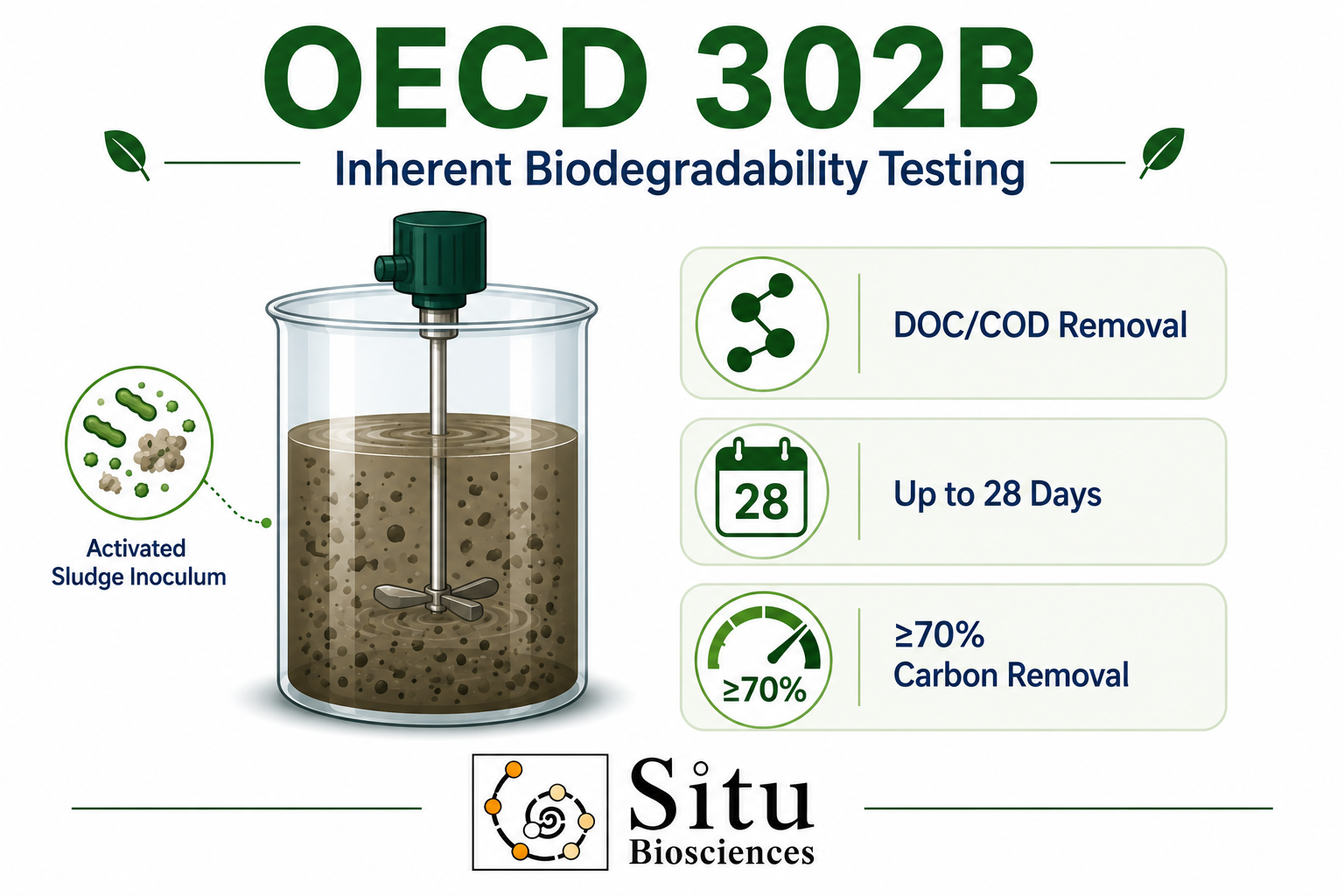
OECD 302B Testing: Zahn-Wellens / EMPA Test for Inherent Biodegradability
What is OECD 302B?
OECD 302B is a standardized test method used to evaluate the inherent biodegradability of a substance under aerobic conditions.
Also known as the Zahn-Wellens / EMPA Test, OECD 302B measures the removal of organic carbon as microorganisms degrade a substance in a controlled aqueous environment.
Overview
OECD 302B is part of the OECD 302 series, which assesses inherent biodegradability rather than ready biodegradability.
This method is commonly used for substances that do not meet the strict criteria of OECD 301 tests but may still demonstrate significant biodegradation under more favorable conditions.
At Situ Biosciences, OECD 302B testing is used to evaluate biodegradation potential, support regulatory assessments, and guide product development.
What OECD 302B Measures
OECD 302B measures the reduction of organic carbon in a test system containing activated sludge or similar microbial inoculum.
The test evaluates biodegradation by:
- Adding the test substance to a mineral medium
- Inoculating with microorganisms (e.g., activated sludge)
- Maintaining aerobic conditions
- Measuring organic carbon removal over time
- Comparing test samples to controls
Results are typically expressed as percent removal of:
- Dissolved Organic Carbon (DOC), or
- Chemical Oxygen Demand (COD)
How OECD 302B Testing Works
1. Sample Preparation
The test substance is added to a mineral medium at a defined concentration, typically higher than OECD 301 tests.
2. Inoculum Addition
Microorganisms are introduced from activated sludge or other environmental sources.
3. Aerobic Incubation
The test system is maintained under aerobic conditions with continuous mixing.
4. Monitoring Period
Samples are collected over time to track degradation progress.
5. Carbon Analysis
DOC or COD is measured to determine how much organic material remains.
6. Calculation of Biodegradation
Biodegradation is calculated as percent removal of organic carbon relative to controls.
Common Test Conditions
| Parameter | Typical Conditions |
|---|---|
| Test Type | Aerobic inherent biodegradability |
| Measurement | DOC or COD removal |
| Duration | Up to 28 days |
| Environment | Aqueous aerobic system |
| Inoculum | Activated sludge |
| Result Expression | Percent carbon removal |
| Standard Organization | OECD |
| Method Name | Zahn-Wellens / EMPA Test |
Benefits of OECD 302B
Evaluates inherent biodegradability
OECD 302B determines whether a substance has biodegradation potential under favorable microbial conditions.
Suitable for complex substances
Effective for materials that may not meet ready biodegradability criteria but still degrade over time.
Flexible measurement options
Allows use of DOC or COD analysis depending on the substance and study design.
Supports regulatory evaluation
Often used in environmental fate assessments and regulatory frameworks.
High microbial activity
Uses a strong microbial inoculum to maximize degradation potential.
Limitations of OECD 302B
Not a ready biodegradability test
Results cannot be used to claim “readily biodegradable.”
Less stringent conditions
The test environment is more favorable than OECD 301 methods, so results are not directly comparable.
Interpretation required
Carbon removal may include adsorption or other non-biological processes.
Longer or variable timelines
Degradation profiles may vary depending on the substance and inoculum.
Why Choose OECD 302B Over Other Methods
| Method | Type | Purpose |
|---|---|---|
| OECD 301A | Ready biodegradability | DOC removal screening |
| OECD 301B | Ready biodegradability | CO₂ evolution |
| OECD 302A | Inherent biodegradability | Activated sludge semi-continuous system |
| OECD 302B | Inherent biodegradability | DOC/COD removal in batch system |
| OECD 302C | Inherent biodegradability | Modified MITI test |
OECD 302B is commonly selected when evaluating whether a substance has inherent biodegradation potential under controlled aerobic conditions with a strong microbial population.
Applications of OECD 302B Testing
Common applications include:
- Environmental fate assessment
- Regulatory submissions
- Product development
- Screening of difficult or poorly biodegradable substances
- Evaluation of formulations
- Supporting biodegradability claims (non-ready)
Frequently Asked Questions
What does OECD 302B measure?
OECD 302B measures the removal of organic carbon (DOC or COD) as microorganisms degrade a substance.
Is OECD 302B a ready biodegradability test?
No. OECD 302B evaluates inherent biodegradability under favorable conditions.
What is the difference between OECD 302A and OECD 302B?
OECD 302A uses a semi-continuous activated sludge system, while OECD 302B is a batch test measuring carbon removal (DOC or COD).
What is considered biodegradable in OECD 302B?
There is no strict pass/fail threshold, but high levels of carbon removal (e.g., >70%) indicate strong inherent biodegradability.
Can OECD 302B be used for regulatory submissions?
Yes. It is commonly used in environmental fate and regulatory evaluations.
our future™ Program – Biodegradability Certification
Situ Biosciences offers the our future™ Program, a data-driven biodegradability certification designed to validate product performance through scientifically backed testing.
The our future™ Certified Biodegradable designation is rooted directly in biodegradation test results generated in our ISO 17025 accredited laboratory. Certification is based on rigorous evaluation using globally recognized test methods, ensuring your product meets defined biodegradability criteria.
By participating in the our future™ Program, companies gain:
- Verified biodegradability certification based on test data
- Transparent reporting, with supporting data available to customers
- Use of the Certified Biodegradable logo for marketing and product claims
- Alignment with global standards and regulatory expectations
This program provides a clear, data-backed way to substantiate biodegradability claims while building trust with customers and stakeholders.
Supported Test Methods
The our future™ Program supports a wide range of biodegradation pathways and materials, including both liquid and solid products.
Ready Biodegradability
OECD 301A, OECD 301B, OECD 301C, OECD 301D, OECD 301E, OECD 301F, OECD 310, ASTM D5864
Inherent Biodegradability
OECD 302B, OECD 302C, OECD 302D
Marine Biodegradability
Anaerobic Biodegradability
Ultimate Biodegradability
Why Enroll in the our future™ Program
Biodegradability claims are increasingly scrutinized across industries. The our future™ Program provides:
- Scientifically defensible claims backed by validated test data
- Improved regulatory alignment across global markets
- A competitive advantage through verified environmental performance
- Confidence for customers and partners through transparent data access
Biodegradation Testing at Situ Biosciences
Situ Biosciences provides biodegradation testing for a wide range of materials including chemicals, polymers, coatings, and formulated products.
Testing programs can be designed to support:
- biodegradability screening
- regulatory compliance
- product development
- environmental claim validation
For more information about OECD 302B testing, please contact Situ Biosciences.