
AATCC TM 100 Antimicrobial Textile Test Method – Antibacterial Finishes on Textile Materials
What is AATCC TM 100?
AATCC TM 100 is a standardized quantitative antimicrobial test method developed by the American Association of Textile Chemists and Colorists. The method measures the reduction of viable bacteria on treated textile materials after a defined incubation period and is commonly used to evaluate antimicrobial textile finishes.
Overview
The method measures the reduction of viable bacteria on a textile specimen after a defined contact period, providing measurable data on antimicrobial performance.
The test is widely used for textiles intended for applications such as medical fabrics, performance apparel, hygiene products, upholstery, and technical textiles where microbial control is desirable.
At Situ Biosciences, AATCC TM 100 testing is performed to evaluate antimicrobial performance, compare antimicrobial formulations, support product development, and validate antimicrobial claims for treated textile materials.
What AATCC TM 100 Measures
AATCC TM 100 measures the quantitative reduction of bacterial populations on treated textile materials relative to untreated controls.
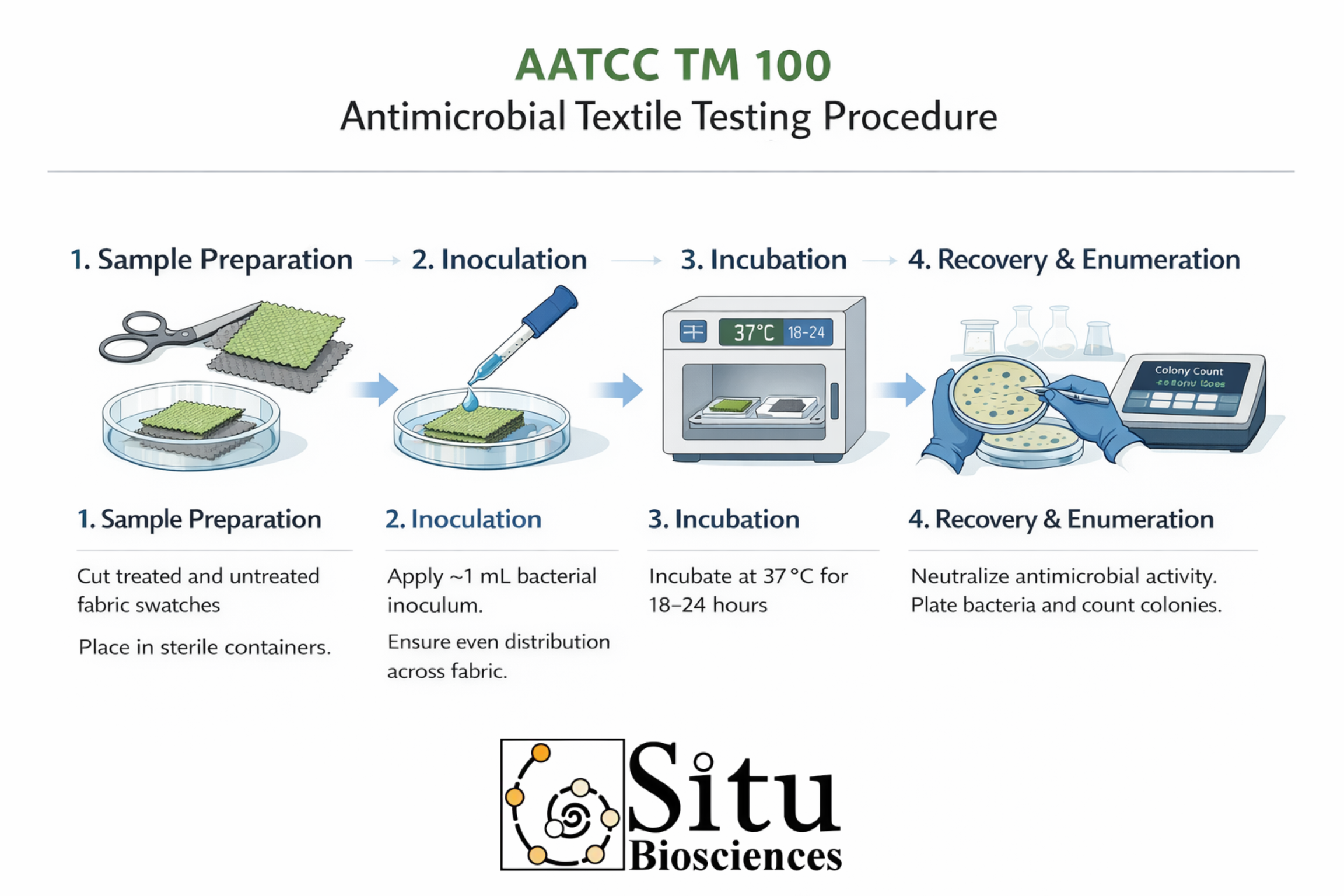
Diagram of the AATCC TM 100 testing process
The test evaluates antimicrobial performance by:
-
Inoculating textile specimens with a known bacterial population
-
Allowing the organisms to contact the textile surface under controlled conditions
-
Recovering surviving bacteria after incubation
-
Quantifying bacterial populations using microbiological plating methods
Results are typically expressed as percent reduction or log reduction of bacterial populations relative to untreated control samples.
Because the method provides numerical reduction values, AATCC TM 100 is commonly used when quantitative antimicrobial performance data is required.
How AATCC TM 100 Testing Works
The method follows a standardized procedure designed to produce reproducible antimicrobial performance data.
1. Sample Preparation
Textile materials are cut into standardized test specimens. Depending on the study design, samples may be conditioned or sterilized prior to testing.
2. Bacterial Inoculation
Each specimen is inoculated with a known concentration of bacteria suspended in a nutrient medium.
3. Contact Period
The inoculated textile samples are incubated under controlled conditions, typically for approximately 18–24 hours, allowing interaction between the microorganisms and the textile surface.
4. Neutralization and Recovery
After incubation, surviving bacteria are extracted from the textile using a neutralizing solution that stops antimicrobial activity.
5. Enumeration of Surviving Bacteria
Recovered bacteria are quantified using standard microbiological plating techniques to determine colony forming units (CFU).
6. Calculation of Antimicrobial Performance
The reduction of bacterial populations on treated samples is compared with untreated controls to calculate percent reduction or log reduction.
Common Test Organisms
AATCC TM 100 is typically performed using standard bacterial strains that represent common Gram-positive and Gram-negative organisms.
| Organism | Type | Relevance |
| Staphylococcus aureus | Gram-positive | Common skin bacterium used in antimicrobial textile testing |
| Klebsiella pneumoniae | Gram-negative | Frequently used to evaluate antimicrobial performance against Gram-negative bacteria |
.
Additional organisms may be evaluated depending on the intended product application.
Key Test Parameters
| Parameter | Typical Conditions |
| Test Type | Quantitative antibacterial reduction |
| Measurement | Colony forming units (CFU) |
| Contact Time | Typically 18–24 hours |
| Result Expression | Percent reduction or log reduction |
| Standard Organization | AATCC (American Association of Textile Chemists and Colorists) |
Benefits of AATCC TM 100
Quantitative antimicrobial measurement
AATCC TM 100 provides numerical measurements of bacterial reduction, allowing accurate comparison of antimicrobial treatments.
Widely recognized textile standard
The method is one of the most commonly used antimicrobial textile test methods globally.
Suitable for treated fabrics
AATCC TM 100 is particularly effective for evaluating antimicrobial finishes applied to textiles.
Supports product development
Manufacturers often use AATCC TM 100 to compare antimicrobial additives, optimize formulations, and validate performance claims.
Adaptable to durability studies
The method can be used to evaluate antimicrobial performance before and after laundering or environmental aging studies.
Limitations of AATCC TM 100
Controlled laboratory conditions
Testing is performed under standardized laboratory conditions and may not fully replicate all real-world environments.
Focus on antibacterial activity
AATCC TM 100 measures antibacterial performance and does not evaluate activity against fungi or viruses unless additional methods are used.
Variability in microbiological testing
Microbiological testing inherently contains variability due to biological systems and complex interactions between microorganisms and materials.
Proper test controls and validation procedures are important to ensure reliable results.
Durability considerations
AATCC TM 100 evaluates antimicrobial performance at the time of testing. When durability is important, antimicrobial testing is often combined with laundering procedures such as AATCC TM 61 or other environmental aging studies to evaluate how antimicrobial performance changes after repeated washing or extended use. This approach is commonly used for athletic apparel, outdoor textiles, and frequently laundered fabrics.
Why Choose AATCC TM 100 Over Other Methods
Several antimicrobial textile test methods exist, each designed for different types of evaluations.
.
| Method | Type | Purpose |
|---|---|---|
| AATCC TM 100 | Quantitative | Measures bacterial reduction directly on textile materials |
| AATCC TM 147 | Qualitative | Screening method evaluating zones of bacterial inhibition |
| JIS L 1902 | Quantitative | International antimicrobial textile test standard |
| ASTM E2149 | Quantitative (Dynamic) | Dynamic shake-flask antimicrobial test commonly used for treated materials |
| AATCC TM 30 | Antifungal | Evaluates fungal resistance in textile materials |
.
AATCC TM 100 is commonly selected when quantitative antimicrobial performance on textile materials must be measured under controlled contact conditions.
Other methods such as ASTM E2149 use a dynamic shake-flask approach where materials are continuously agitated in a bacterial suspension. Because of the highly diluted and dynamic conditions used in the method, ASTM E2149 is generally considered less sensitive for evaluating antimicrobial performance on textiles compared with direct-contact textile methods such as AATCC TM 100.
Improving Test Reliability with Certified Reference Materials
Microbiological testing methods such as AATCC TM 100 can exhibit variability due to the complexity of biological systems and test materials. One approach to improving reliability and confidence in test results is the use of Certified Reference Materials (CRMs).
Situ Biosciences provides Certified Reference Materials for antimicrobial testing that are specifically designed to validate method performance and ensure proper test controls.
Certified Reference Materials can be used to:
-
Confirm proper method performance
-
Validate laboratory proficiency
-
Support ISO 17025 quality control procedures
-
Reduce the likelihood of inconclusive or invalid test results
Situ Biosciences CRMs are produced in accordance with ISO 17034 requirements and verified using ISO 17025 testing methods.
Learn more about these materials here:
https://www.situbiosciences.com/product/certified-reference-materials-for-antimicrobial-testing/
Applications of AATCC TM 100 Testing
AATCC TM 100 is widely used across industries for evaluating antimicrobial textile performance.
Common applications include:
-
Medical and healthcare textiles
-
Athletic and performance apparel
-
Bedding and hygiene products
-
Upholstery fabrics
-
Technical and industrial textiles
-
Antimicrobial treated fabrics
Frequently Asked Questions
What does AATCC TM 100 measure?
AATCC TM 100 measures the quantitative reduction of bacterial populations on treated textile materials after incubation.
How long does AATCC TM 100 testing take?
Typical studies require several days including sample preparation, incubation, microbial recovery, and enumeration.
Can AATCC TM 100 evaluate antimicrobial durability?
Yes. The test can be performed before and after laundering or environmental exposure to evaluate durability of antimicrobial treatments.
What is the difference between AATCC TM 100 and AATCC TM 147?
AATCC TM 100 is a quantitative antimicrobial test method that measures the reduction of bacterial populations on textile materials.
AATCC TM 147 is a qualitative screening test that evaluates zones of bacterial inhibition around treated textile samples.
What level of bacterial reduction is considered effective?
In many applications, antimicrobial textiles demonstrating greater than 99% bacterial reduction (2-log reduction) are considered to have meaningful antibacterial performance, although requirements vary by product and application.
Antimicrobial Textile Testing at Situ Biosciences
Situ Biosciences provides antimicrobial testing for a wide range of materials including textiles, polymers, foams, coatings, and treated surfaces.
Testing programs can be designed to support:
-
antimicrobial performance validation
-
product development
-
durability evaluation
-
regulatory or certification requirements
For more information about antimicrobial textile testing or Certified Reference Materials, please contact Situ Biosciences.