
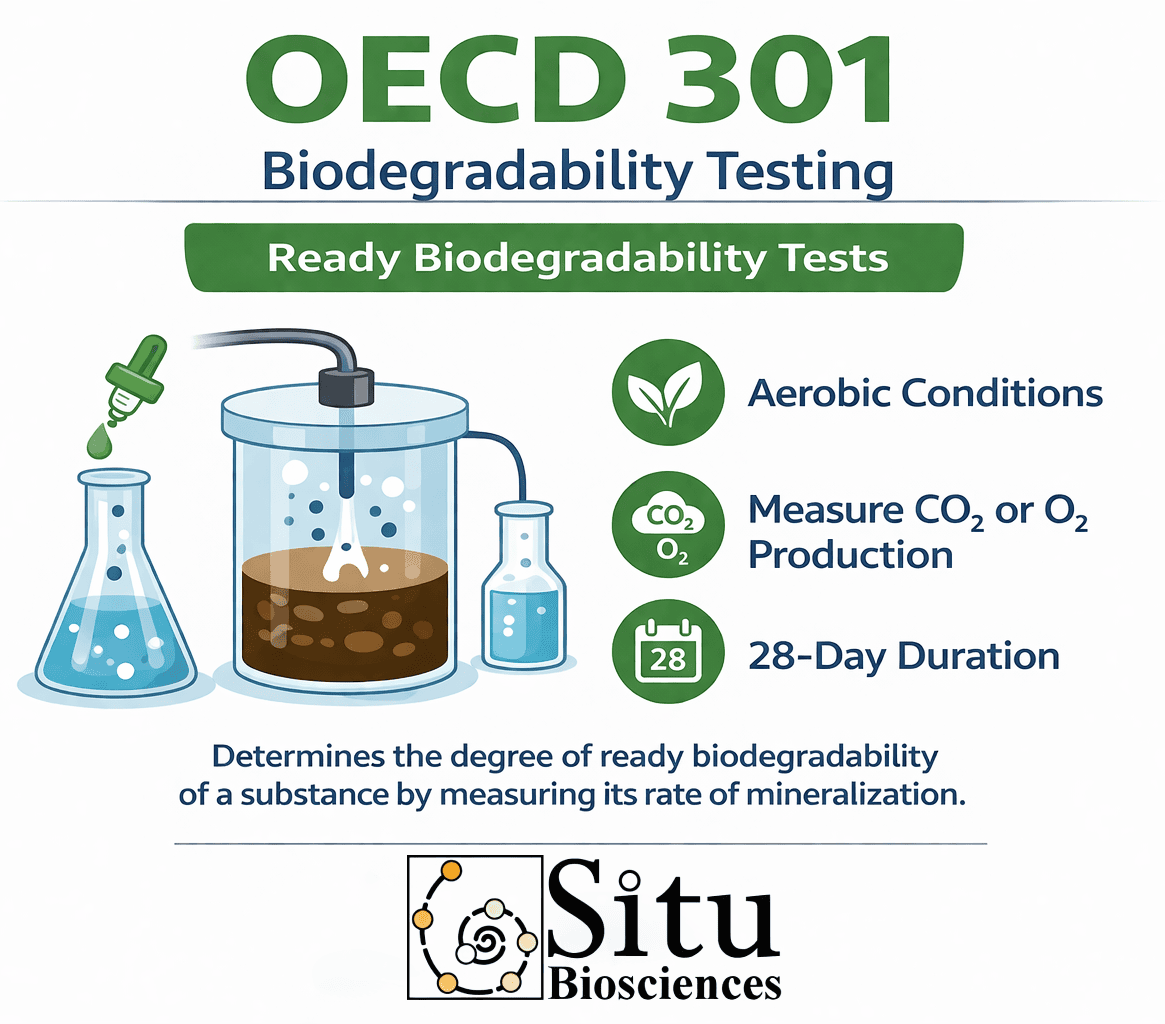
OECD 301 Biodegradability Testing – Ready Biodegradability Methods A–F
What is OECD 301?
OECD 301 is a group of standardized test methods used to evaluate the ready biodegradability of substances under aerobic aqueous conditions. These methods measure how effectively microorganisms degrade a substance over time using parameters such as dissolved organic carbon removal, carbon dioxide evolution, or oxygen uptake.
Overview
The OECD 301 series includes six screening methods for ready biodegradability:
- OECD 301A – DOC Die-Away
- OECD 301B – CO₂ Evolution (Modified Sturm Test)
- OECD 301C – Modified MITI (I)
- OECD 301D – Closed Bottle
- OECD 301E – Modified OECD Screening Test
- OECD 301F – Manometric Respirometry Test
These methods are widely used for environmental screening, regulatory submissions, and product development. They are designed to determine whether a substance can be classified as readily biodegradable under defined laboratory conditions.
At Situ Biosciences, OECD 301 testing is performed to support biodegradability evaluation, regulatory decision-making, and environmental claim development.
What OECD 301 Measures
The OECD 301 series measures biodegradation using one of several standardized endpoints depending on the selected method.
The test methods evaluate biodegradation by:
- Inoculating the test substance into a mineral medium under aerobic conditions
- Using microorganisms from activated sludge, sewage effluent, surface water, or other approved inoculum sources
- Monitoring degradation over time using DOC removal, CO₂ production, or oxygen consumption
- Comparing measured biodegradation to theoretical or expected values such as ThOD or ThCO₂
Depending on the method, results are typically expressed as:
- Percent DOC removal
- Percent biodegradation based on theoretical CO₂ production (ThCO₂)
- Percent biodegradation based on theoretical oxygen demand (ThOD)
Because the OECD 301 series includes multiple analytical approaches, it allows method selection based on substance properties such as solubility, volatility, and adsorption behavior.
How OECD 301 Testing Works
The OECD 301 series follows a common general principle, with analytical differences depending on the method selected.
1. Sample Preparation
The test substance is added to a mineral medium as the principal carbon source. The concentration depends on the selected method and analytical endpoint.
2. Inoculum Addition
A microbial inoculum is introduced from an approved environmental source such as activated sludge, sewage effluent, or surface water.
3. Aerobic Incubation
The test system is maintained under aerobic conditions, typically in the dark or diffuse light, for up to 28 days.
4. Analytical Monitoring
Biodegradation is monitored using the endpoint defined by the method:
- DOC removal
- CO₂ evolution
- Oxygen uptake
5. Blank and Reference Controls
Parallel inoculum blanks and reference compounds are included to verify method performance and account for endogenous microbial activity.
6. Calculation of Biodegradation
The measured degradation endpoint is compared to a theoretical value to determine percent biodegradation and whether the pass criteria for ready biodegradability are met.
OECD 301 Methods Overview
| Method | Name | Measurement Endpoint | Typical Use |
|---|---|---|---|
| OECD 301A | DOC Die-Away | Dissolved organic carbon removal | Soluble, non-volatile substances |
| OECD 301B | CO₂ Evolution | Carbon dioxide production | Direct mineralization measurement |
| OECD 301C | Modified MITI (I) | Oxygen uptake | Standardized respirometric screening |
| OECD 301D | Closed Bottle | Dissolved oxygen consumption | Low concentration testing |
| OECD 301E | Modified OECD Screening | Dissolved organic carbon removal | Low inoculum DOC-based screening |
| OECD 301F | Manometric Respirometry | Oxygen uptake | Automated closed-system respirometry |
Common Test Conditions
| Parameter | Typical Conditions |
|---|---|
| Test Type | Aerobic ready biodegradability |
| Duration | Typically 28 days |
| Environment | Aqueous aerobic system |
| Inoculum | Activated sludge, effluent, or environmental microorganisms |
| Result Expression | DOC removal, ThCO₂, or ThOD |
| Standard Organization | OECD |
Pass Criteria for Ready Biodegradability
In the OECD 301 series, a substance is generally considered readily biodegradable when it reaches the applicable pass level within the required test period.
Typical pass criteria include:
- 70% DOC removal for DOC-based methods
- 60% ThOD or ThCO₂ for respirometric and CO₂-based methods
For most OECD 301 methods, these pass levels must be achieved within a 10-day window during the 28-day test. The 10-day window begins once degradation first reaches 10%. Exceptions apply for certain methods, such as OECD 301C, where the 10-day window concept does not apply.
Benefits of OECD 301 Testing
Widely recognized regulatory framework
The OECD 301 series is globally recognized for biodegradability screening and environmental assessment.
Multiple analytical options
The availability of six methods allows selection based on substance characteristics and study goals.
Useful for screening and development
OECD 301 methods are commonly used for early-stage screening, formulation comparison, and environmental assessment.
Supports environmental and regulatory evaluation
The data generated can support regulatory submissions and biodegradability classification.
Standardized methodology
The methods use defined conditions and controls to improve reproducibility and comparability.
Limitations of OECD 301 Testing
Strict screening criteria
OECD 301 methods are designed as screening tests for ready biodegradability, meaning the criteria are intentionally stringent.
Controlled laboratory conditions
Results are generated under standardized conditions and may not fully reflect all environmental settings.
Method suitability depends on substance properties
Solubility, volatility, and adsorption behavior can affect which OECD 301 method is most appropriate.
Low pass result does not necessarily mean non-biodegradable
If a substance does not meet OECD 301 criteria, additional testing may still show biodegradation under other conditions or over longer periods.
Why Choose One OECD 301 Method Over Another
The six OECD 301 methods are intended for similar screening purposes, but different methods may be more suitable depending on the substance and the desired endpoint.
OECD 301A and OECD 301E
These methods are useful when DOC removal is the preferred analytical endpoint and the substance is sufficiently soluble.
OECD 301B
This method is often selected when direct mineralization to CO₂ is preferred.
OECD 301C and OECD 301F
These methods are useful when oxygen uptake and respirometric monitoring are preferred.
OECD 301D
This method is commonly used when testing at low concentrations in a closed bottle system is desired.
At Situ Biosciences, method selection is guided by test substance properties, study goals, and applicable regulatory considerations.
our future™ Program – Biodegradability Certification
Situ Biosciences offers the our future™ Program, a data-driven biodegradability certification designed to validate product performance through scientifically backed testing.
The our future™ Certified Biodegradable designation is rooted directly in biodegradation test results generated in our ISO 17025 accredited laboratory. Certification is based on rigorous evaluation using globally recognized test methods, ensuring your product meets defined biodegradability criteria.
By participating in the our future™ Program, companies gain:
- Verified biodegradability certification based on test data
- Transparent reporting, with supporting data available to customers
- Use of the Certified Biodegradable logo for marketing and product claims
- Alignment with global standards and regulatory expectations
This program provides a clear, data-backed way to substantiate biodegradability claims while building trust with customers and stakeholders.
Supported Test Methods
The our future™ Program supports a wide range of biodegradation pathways and materials, including both liquid and solid products.
Ready Biodegradability
OECD 301A, OECD 301B, OECD 301C, OECD 301D, OECD 301E, OECD 301F, OECD 310, ASTM D5864
Inherent Biodegradability
OECD 302B, OECD 302C, OECD 302D
Marine Biodegradability
Anaerobic Biodegradability
Ultimate Biodegradability
Why Enroll in the our future™ Program
Biodegradability claims are increasingly scrutinized across industries. The our future™ Program provides:
- Scientifically defensible claims backed by validated test data
- Improved regulatory alignment across global markets
- A competitive advantage through verified environmental performance
- Confidence for customers and partners through transparent data access
Get Started
To learn more about the our future™ Program or begin certification:
📞 847-483-9950
📧 info@situtest.com
Applications of OECD 301 Testing
OECD 301 testing is widely used across industries for evaluating ready biodegradability.
Common applications include:
- Chemical screening
- Product development
- Regulatory submissions
- Environmental impact assessments
- Comparison of alternative formulations
- Support for biodegradability claims
Frequently Asked Questions
What does OECD 301 measure?
OECD 301 measures ready biodegradability under aerobic aqueous conditions using endpoints such as DOC removal, CO₂ evolution, or oxygen uptake.
How many OECD 301 methods are there?
There are six methods in the OECD 301 series: 301A, 301B, 301C, 301D, 301E, and 301F.
How long do OECD 301 tests take?
OECD 301 methods run for up to 28 days
What is the difference between OECD 301 and OECD 302?
OECD 301 methods evaluate ready biodegradability, while OECD 302 methods evaluate inherent biodegradability, which generally uses less stringent criteria.
Which OECD 301 method should I choose?
The best method depends on the substance’s solubility, volatility, adsorption behavior, and the endpoint required for the study.
Biodegradation Testing at Situ Biosciences
Situ Biosciences provides biodegradation testing for a wide range of materials including chemicals, polymers, coatings, and formulated products.
Testing programs can be designed to support:
- biodegradability screening
- regulatory compliance
- product development
- environmental claim validation
For more information about OECD 301 biodegradability testing, please contact Situ Biosciences.