
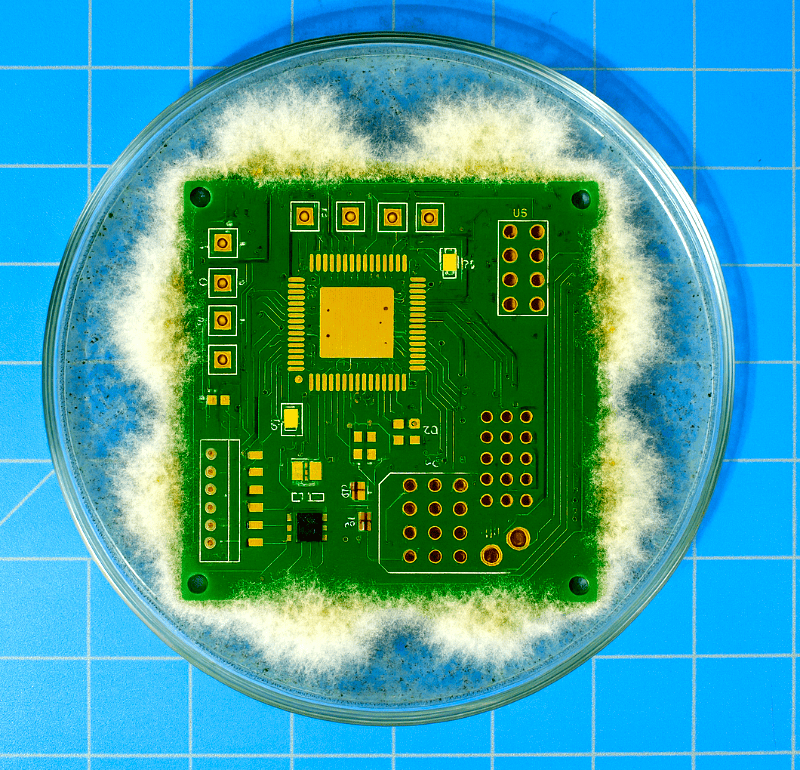
IPC-TM-650 2.6.1 – Fungus Resistance of Printed Board Materials
IPC-TM-650 2.6.1 Fungus Resistance of Printed Board Materials is an industry standard test method providing controlled fungal resistance evaluation of circuit board materials.
As one of the most commonly referenced IPC fungal resistance tests, IPC-TM-650 2.6.1 is used to determine if a printed board material will support fungal growth under high-humidity, warm conditions favorable to microbial development.
Fungal growth can have long-term impacts on electronic substrates, coatings, and insulation materials. Growth on these components can directly affect electrical isolation, accelerate corrosion, or degrade the physical properties of materials used in circuit boards and assemblies.
To prevent these types of fungi-related failures, it is important to assess fungal growth resistance in a way that simulates the product’s long-term service environment. The standard method exposes test specimens to 30 ± 1 °C and 95 ± 2% relative humidity, with inoculation from a mixed spore suspension containing Aspergillus niger, Chaetomium globosum, Gliocladium virens, Aureobasidium pullulans, and Penicillium funiculosum. Over a set incubation period, fungal activity and material deterioration are monitored to evaluate susceptibility.
Electronics, aerospace, automotive, and defense products are commonly required to undergo this type of fungal resistance testing to determine how microorganism growth could affect product performance in the field. Because fungi are difficult to control, laboratory testing is essential for predicting long-term durability and selecting antifungal coatings or treatments suitable for use in demanding applications.
For more information on IPC-TM-650 2.6.1 testing and Antimicrobial testing, contact our antimicrobial laboratory at 847-483-9950 or info@situtest.com.