
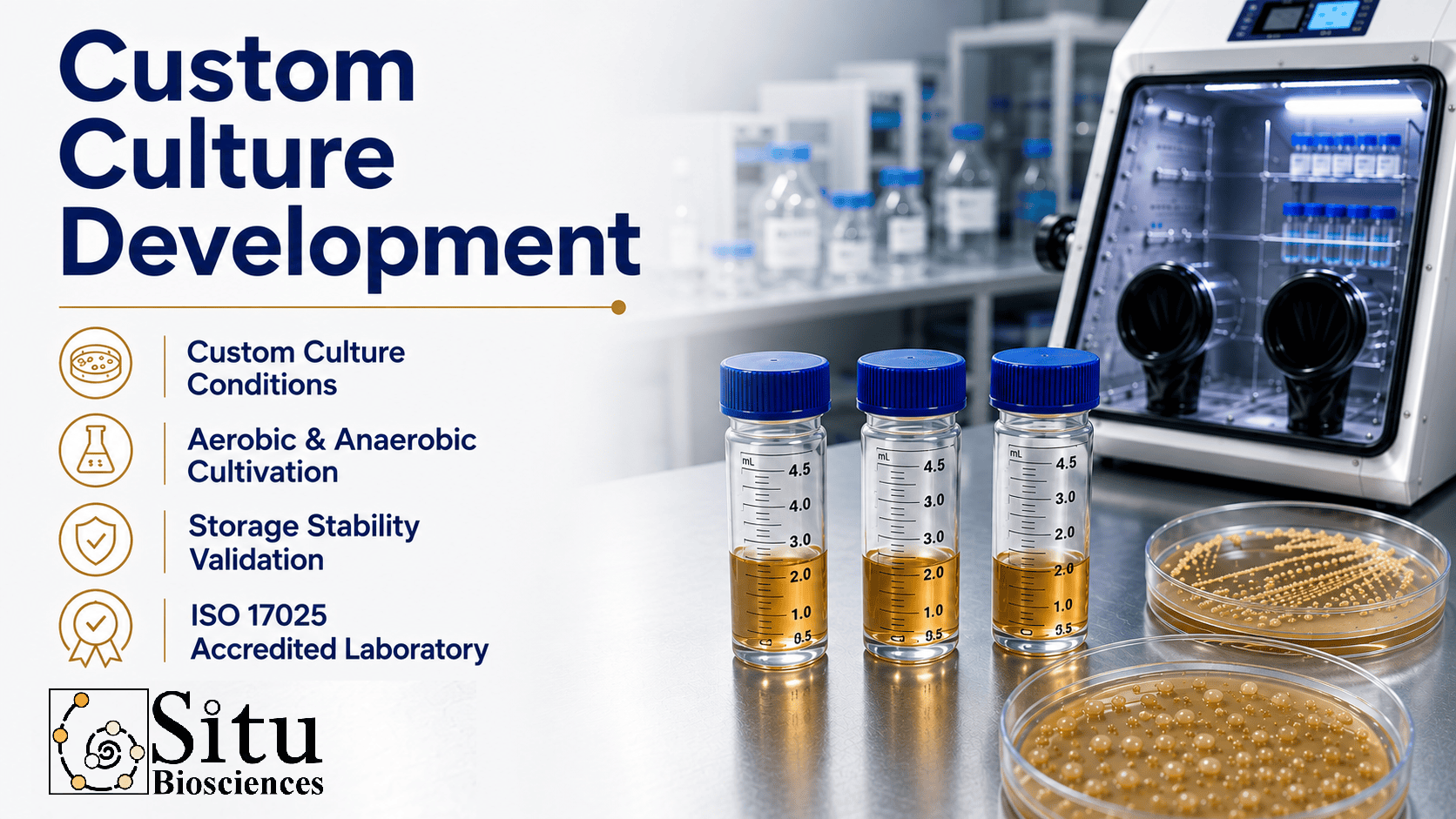
Microorganism Culture Development for Pharmaceutical, Biotechnology, and Diagnostic Applications
What is Custom Culture Development?
Custom culture development is the process of growing microorganisms under laboratory conditions tailored to the specific needs of a strain, organism group, or project objective. In pharmaceutical microbiology, biotechnology, and diagnostic assay development, custom culture development is used when standard culture conditions are not sufficient to achieve target concentrations, maintain viability, or support reproducible downstream testing.
Custom culture development may include microbial strain sourcing, custom bacterial culture development, anaerobic and aerobic culture services, media optimization, culture scale-up, quantitative titer determination, and storage stability validation. These services are commonly used when organizations need well-characterized microbial cultures, defined CFU/mL targets, or organism-specific growth conditions to support assay development, microbial testing, product validation, and biological research.
Overview
Custom culture development supports projects that require well-characterized microbial cultures grown under conditions specific to the organism and intended application. This may include custom microbial culture preparation for pharmaceutical studies, diagnostic assay validation, microbial challenge testing, research and development, or biotechnology process support.
Some microorganisms require specialized media, anaerobic environments, extended incubation periods, strain-specific handling procedures, or custom recovery methods in order to achieve acceptable growth and viability. Others may require target titer preparation, organism expansion from client-supplied stocks, or post-processing validation to confirm that the culture remains suitable for use.
At Situ Biosciences, custom culture development is used to support pharmaceutical companies, biotechnology developers, diagnostic manufacturers, and other clients that need custom microbial culture services, microbial strain expansion, and quantitative culture preparation for research, testing, and development programs.
What Custom Culture Development Measures
Custom culture development evaluates the ability to grow, recover, quantify, and maintain microorganisms under defined laboratory conditions.
The process may assess culture performance by:
- Selecting growth conditions appropriate for the organism
- Achieving target microbial concentrations such as 1 × 10⁶ CFU/mL, 1 × 10⁷ CFU/mL, or other project-specific titers
- Confirming viable recovery after growth, storage, or processing
- Evaluating storage stability viability when required
- Assessing media suitability and growth behavior
- Documenting quantitative titer, culture performance, and microbial recovery
Results are typically expressed as microbial concentration, such as CFU/mL, along with supporting observations related to growth, viability, recovery, and handling stability.
Key Development Parameters
| Parameter | Typical Considerations |
|---|---|
| Culture Type | Aerobic, anaerobic, yeast, or specialized organism culture |
| Measurement | CFU/mL, viable recovery, or project-specific endpoint |
| Growth Conditions | Media, temperature, atmosphere, and incubation duration |
| Target Concentration | Defined based on project requirements, such as 1E6 CFU/mL, 1E7 CFU/mL, or higher |
| Validation | Titer determination, viability confirmation, or storage stability validation |
| Application | Pharmaceutical, diagnostic, biotechnology, or microbial product testing support |
Benefits of Custom Culture Development
Tailored organism-specific growth conditions
Culture conditions are developed around the biological requirements of the organism rather than relying solely on routine laboratory methods. This can improve growth, recovery, and consistency for pharmaceutical microbial culture programs and custom assay support.
Supports difficult-to-culture microorganisms
Custom development can help address strains that require specialized media, anaerobic conditions, custom handling, or extended incubation.
Quantitative culture verification
Titer determination helps confirm microbial concentration and supports reproducible downstream testing. This is especially important when clients require defined CFU/mL, validated inocula, or challenge cultures.
Improves study consistency
Well-characterized cultures can reduce variability during assay development, diagnostic validation, product testing, and microbial challenge studies.
Supports pharmaceutical and diagnostic development
Custom cultures can support method development, diagnostic assay validation, pharmaceutical microbiology studies, microbial challenge testing, and research programs requiring reliable biological materials.
Flexible project design
Culture conditions, target concentrations, reporting requirements, organism sourcing, and validation steps can be tailored to the goals of each project.
Limitations of Custom Culture Development
Organism-specific variability
Different strains may vary in growth rate, viability, recovery, and response to handling or storage.
Source material availability
Project timelines may depend on culture collection availability, customer-supplied stocks, or strain procurement lead times.
Optimization may be required
Some organisms may require iterative testing, media adjustments, or multiple cultivation attempts to achieve target titers or stable recovery.
Not all organisms are feasible
Certain organisms may present biosafety, sourcing, viability, or growth limitations that affect feasibility.
Timeline variability
Turnaround time depends on organism complexity, growth rate, media requirements, scale-up needs, and validation requirements.
Why Choose Custom Culture Development Over Standard Culture Preparation
| Approach | Purpose |
|---|---|
| Standard Culture Preparation | Uses routine growth conditions for organisms with well-established culture requirements |
| Custom Culture Development | Tailors growth conditions, target titers, and validation steps to specific organisms and project goals |
| Storage Stability Validation | Confirms culture recovery after storage or handling |
| Media Optimization | Improves growth performance for challenging organisms |
| Quantitative Titer Verification | Confirms organism concentration for downstream testing or validation |
Custom culture development is typically selected when organism growth, recovery, target concentration, shipping viability, or downstream assay performance must be confirmed before the culture is used in a study or development program.
Applications of Custom Culture Development
Custom culture development is used in projects where consistent, well-characterized microbial materials are needed to support research, testing, product development, or regulated laboratory programs.
Common applications include:
- Pharmaceutical microbiology services
- Diagnostic assay development
- Custom microbial culture preparation
- Microbial challenge studies
- Culture expansion for customer-supplied strains
- Storage Stability recovery studies
- Media optimization for difficult-to-culture organisms
- Viability and titer confirmation
- Biotechnology microbial testing services
- Microbial method development
- Organism sourcing and culture scale-up
- Preparation of microbial materials for assay validation
- Support for antimicrobial testing and biological product development
Frequently Asked Questions
What is custom culture development?
Custom culture development is the process of growing microorganisms under defined, organism-specific laboratory conditions to achieve project goals such as target concentration, viability, reproducibility, and downstream assay suitability.
What types of organisms can be cultured?
Custom culture development may include aerobic bacteria, anaerobic bacteria, yeasts, and other microorganisms depending on strain requirements and project feasibility.
Can target titers be requested?
Yes. Target titers can be defined as part of the project scope. Feasibility depends on the organism, culture conditions, growth characteristics, and required deliverables. Common requests include 1E6 CFU/mL, 1E7 CFU/mL, or higher.
How are culture concentrations reported?
Culture concentrations are commonly reported as CFU/mL when culture-based enumeration is appropriate.
Can customer-supplied strains be used?
Yes. Customer-supplied strains may be used when appropriate documentation, shipping, handling, and biosafety requirements are met.
Can Situ Biosciences source organisms as well?
Depending on the project, organisms may be sourced from recognized culture collections such as ATCC, BEI Resources, or other approved suppliers. Customer-supplied cultures may also be used.
How long does custom culture development take?
Turnaround time depends on the number of organisms, growth requirements, optimization needs, culture sourcing lead times, and validation requirements.
Microbial Culture Development at Situ Biosciences
Situ Biosciences provides custom culture development services for pharmaceutical, biotechnology, diagnostic, and product development programs.
Testing and development programs can support:
- custom culture condition development
- custom bacterial culture development
- aerobic and anaerobic organism cultivation
- quantitative titer determination
- microbial titer preparation
- culture performance evaluation
- microbial strain expansion
- project-specific pharmaceutical microbiology support
Whether the goal is assay development, diagnostic validation, product testing, microbial challenge material preparation, or microbial research, custom culture development can help ensure consistent and reproducible biological materials throughout a project lifecycle.
For more information about custom culture development, microbial culture services, or pharmaceutical microbiology support, please contact Situ Biosciences.