
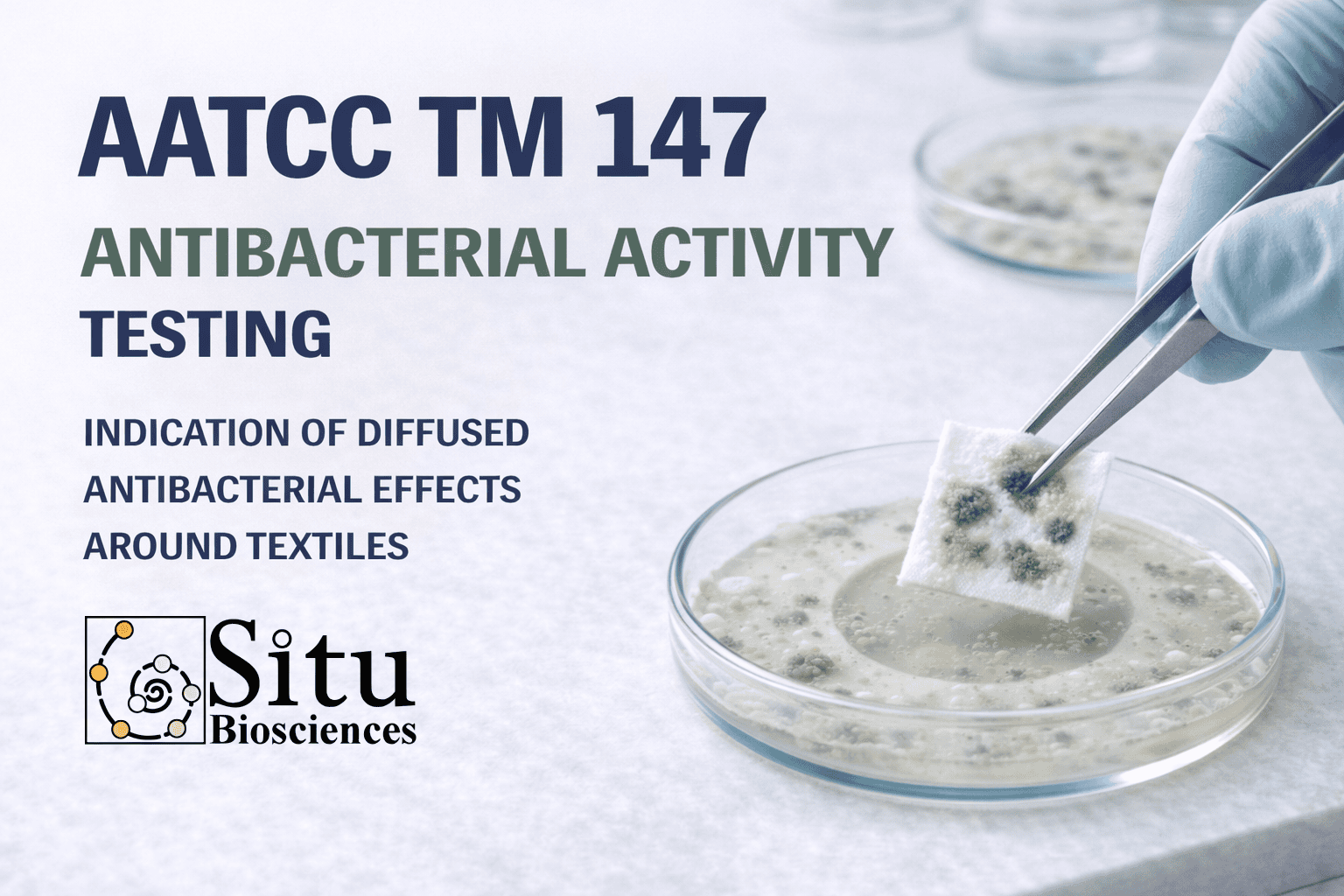
AATCC TM147 testing evaluates antibacterial activity by observing the inhibition of bacterial growth on agar surrounding treated textile samples.
AATCC TM147 Testing: Antibacterial Activity of Textiles (Parallel Streak Method)
What is AATCC TM147?
AATCC TM147 is a qualitative test method used to evaluate the antibacterial activity of textile materials by measuring the inhibition of bacterial growth on agar surfaces.
The method determines whether antibacterial agents diffuse from the textile and inhibit bacterial growth in the surrounding area.
Overview
AATCC TM147, also known as the Parallel Streak Method, is a rapid screening test used to assess antibacterial-treated textiles.
Unlike quantitative methods, TM147 evaluates antibacterial activity based on the presence of a zone of inhibition, making it useful for identifying materials with diffusible antimicrobial agents.
At Situ Biosciences, AATCC TM147 testing is used for early-stage screening, product comparison, and demonstrating antibacterial functionality in treated textiles.
What AATCC TM147 Measures
AATCC TM147 measures antibacterial activity based on:
- Presence of bacterial growth inhibition
- Width of the inhibition zone (mm)
- Contact inhibition directly beneath the sample
The method evaluates how effectively an antimicrobial agent diffuses from the textile into the surrounding agar.
Results are qualitative and based on:
- Clear zone of inhibition
- Reduced bacterial growth near the sample
- No inhibition (growth directly adjacent to sample)
How AATCC TM147 Testing Works
AATCC TM147 follows a diffusion-based microbiological procedure.
1. Preparation of Agar Plates
Sterile nutrient agar is poured into petri dishes and allowed to solidify.
2. Inoculation of Bacteria
Parallel streaks of bacteria are applied across the agar surface.
3. Placement of Test Specimen
The textile specimen is placed across the bacterial streaks to ensure direct contact.
4. Incubation
Plates are incubated at:
- 37 ± 2°C
- 18–24 hours
5. Evaluation of Inhibition
After incubation, plates are examined for:
- Zones of inhibition extending beyond the specimen
- Suppression of growth directly beneath the specimen
6. Measurement of Zone Width
If present, the inhibition zone is measured using:
W = (T − D) / 2
Where:
- W = width of inhibition zone
- T = total diameter including clear zone
- D = specimen width
Common Test Organisms
Typical organisms used include:
| Organism | Relevance |
|---|---|
| Staphylococcus aureus | Gram-positive bacteria |
| Klebsiella pneumoniae | Gram-negative bacteria |
Additional organisms may be used depending on application requirements.
Key Test Parameters
| Parameter | Typical Conditions |
|---|---|
| Test Type | Qualitative antibacterial |
| Measurement | Zone of inhibition (mm) |
| Temperature | 37 ± 2°C |
| Duration | 18–24 hours |
| Material Type | Textiles |
| Endpoint | Growth inhibition |
| Standard Organization | AATCC |
Benefits of AATCC TM147
Fast and cost-effective screening method
Provides rapid assessment of antibacterial activity.
Simple and widely used
Commonly used for textile antimicrobial evaluation.
Visual and easy to interpret
Clear zones of inhibition provide immediate results.
Useful for diffusible antimicrobials
Effective for coatings and treatments designed to release active agents.
Limitations of AATCC TM147
Qualitative method
Does not provide quantitative log reduction values.
Dependent on diffusion
Non-leaching or bound antimicrobials may not show inhibition zones.
Not representative of all real-world conditions
Results depend on agar diffusion rather than surface contact performance.
Limited for regulatory claims
Often requires follow-up quantitative testing (e.g., AATCC TM100).
Why Choose AATCC TM147 Over Other Methods
| Method | Type | Application |
|---|---|---|
| AATCC TM147 | Qualitative antibacterial | Textiles |
| AATCC TM100 | Quantitative antibacterial | Textiles |
| ISO 22196 | Quantitative antibacterial | Non-porous surfaces |
| JIS L 1902 | Quantitative antibacterial | Textiles |
AATCC TM147 is best suited for rapid screening of antibacterial activity and diffusion-based performance.
Improving Test Reliability with Certified Reference Materials
Qualitative methods like AATCC TM147 can vary depending on inoculum preparation, agar composition, and operator technique.
Certified Reference Materials (CRMs) help:
- Validate test system performance
- Confirm bacterial viability
- Improve reproducibility
- Support ISO 17025 compliance
Situ Biosciences provides CRMs produced in accordance with ISO 17034 and verified using ISO 17025 testing methods.
Learn more here:
https://www.situbiosciences.com/product/certified-reference-materials-for-antimicrobial-testing/
Applications of AATCC TM147 Testing
AATCC TM147 is commonly used for:
- Antibacterial textile screening
- Product development and formulation comparison
- Coating and treatment evaluation
- Early-stage antimicrobial validation
- Quality control testing
Frequently Asked Questions
What does AATCC TM147 measure?
It measures antibacterial activity through inhibition of bacterial growth on agar.
What is a zone of inhibition?
A clear area around the sample where bacteria do not grow.
Is AATCC TM147 quantitative?
No. It is a qualitative screening method.
Why might there be no inhibition zone?
Some antimicrobials do not diffuse and only work on contact.
When should I use TM147 vs TM100?
TM147 is for screening; TM100 is for quantitative performance.
AATCC TM147 Testing at Situ Biosciences
Situ Biosciences provides AATCC TM147 testing for rapid evaluation of antibacterial textile performance.
Testing programs can be designed to support:
- product screening
- comparative analysis
- formulation optimization
- antimicrobial validation
For more information about AATCC TM147 testing or Certified Reference Materials, please contact Situ Biosciences.
References
AATCC TM147 — Antibacterial Activity Assessment of Textile Materials: Parallel Streak Method
Product Tests
Biodegradation Testing
Analytical Testing
Formulation Analytical Analysis
Product Development
Environmental & Durability Testing
Biodegradability Testing – Chemical Impact
Minimun Inhibitory Concentration
Minimum Biocidal Concentration
Quality Control Testing
Environmental Fate & Toxicology