
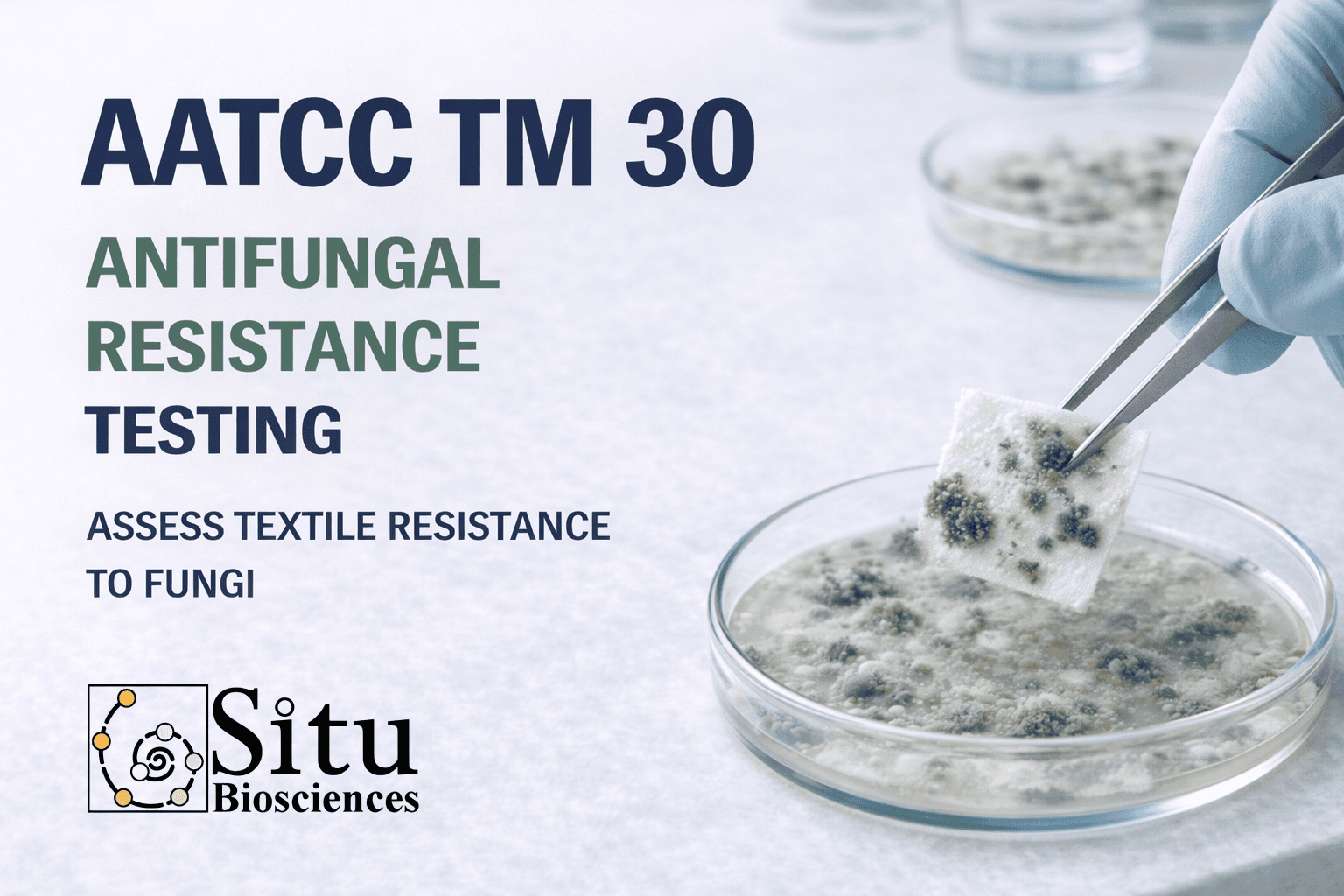
AATCC TM30 testing evaluates antifungal resistance by assessing fungal growth and material degradation of textile samples under controlled environmental conditions.
AATCC TM30 Testing: Antifungal Activity of Textiles (Mildew and Rot Resistance)
What is AATCC TM30?
AATCC TM30 is a standardized test method used to evaluate the antifungal performance of textile materials, including resistance to mildew growth and structural degradation (rot).
The method assesses both:
- Fungal growth on textiles (mildew)
- Material deterioration due to fungi (rot)
Overview
AATCC TM30 is a comprehensive antifungal test method consisting of multiple procedures designed to simulate different real-world exposure conditions.
The method allows testing based on end-use scenarios, including:
- Soil exposure
- High humidity environments
- Outdoor conditions
- Nutrient-rich contamination
At Situ Biosciences, AATCC TM30 testing is used to evaluate antifungal treatments, validate product durability, and support claims related to mildew and fungal resistance.
What AATCC TM30 Measures
AATCC TM30 evaluates antifungal performance through:
- Fungal growth (qualitative or semi-quantitative)
- Material degradation (strength loss)
- Visual mildew formation
Key outputs include:
- Presence or absence of fungal growth
- Extent of surface coverage
- Percent retained tensile strength after exposure
How AATCC TM30 Testing Works
AATCC TM30 includes four distinct test approaches depending on application.
Test I – Soil Burial (Most Severe)
- Samples are buried in biologically active soil
- Incubated for 2–16 weeks
- Evaluated for loss of tensile strength
- Simulates direct soil exposure
Test II – Agar Plate (Chaetomium globosum)
- Cellulose-containing textiles placed on agar
- Inoculated with fungi
- Evaluated for rot resistance and strength loss
Test III – Agar Plate (Aspergillus niger)
- Focuses on surface fungal growth (mildew)
- Measures visible growth and growth-free zones
Test IV – Humidity Chamber (Mixed Fungi)
- Samples exposed to high humidity (~90%)
- Inoculated with mixed fungal spores
- Evaluated visually over up to 4 weeks
Each test is selected based on the expected real-world conditions of the material.
Common Test Organisms
AATCC TM30 uses several fungi depending on the test type:
| Organism | Relevance |
|---|---|
| Chaetomium globosum | Cellulose degradation (rot) |
| Aspergillus niger | Surface mildew growth |
| Trichoderma viride | Environmental fungi |
| Penicillium varians | Mixed spore exposure |
Key Test Parameters
| Parameter | Typical Conditions |
|---|---|
| Test Type | Qualitative / semi-quantitative antifungal |
| Measurement | Growth rating and/or strength loss |
| Temperature | ~28°C |
| Humidity | Up to 90% RH |
| Duration | Days to weeks (test dependent) |
| Material Type | Textiles |
| Endpoint | Visual growth / tensile strength |
| Standard Organization | AATCC |
Benefits of AATCC TM30
Multiple real-world simulation options
Allows testing under soil, humidity, and nutrient-rich conditions.
Evaluates both mildew and structural damage
Provides insight into both aesthetics and durability.
Flexible method selection
Tests can be tailored based on end-use exposure.
Widely recognized textile standard
Established method for antifungal textile evaluation.
Supports product development and durability claims
Useful for outdoor, industrial, and protective textiles.
Limitations of AATCC TM30
Primarily qualitative or semi-quantitative
Does not provide precise log reduction values like antimicrobial methods.
Longer test durations
Some procedures require weeks of incubation.
Variability in environmental simulation
Results can depend on selected test type and conditions.
Requires interpretation of visual growth
Subjectivity may be introduced without standardized rating criteria.
Why Choose AATCC TM30 Over Other Methods
| Method | Type | Application |
|---|---|---|
| AATCC 30 | Antifungal (multiple versions) | Textiles |
| ASTM G21 | Fungal resistance (visual rating) | Polymeric materials |
| AATCC 30pt3 | Antifungal | Textile |
| ISO 18184 | Antiviral | Textiles |
AATCC TM30 is best suited for evaluating fungal resistance of textiles under realistic environmental conditions.
Improving Test Reliability with Certified Reference Materials
Fungal testing can vary due to environmental conditions, inoculum preparation, and biological variability.
Certified Reference Materials (CRMs) help:
- Verify fungal activity and test validity
- Improve reproducibility across studies
- Support method validation
- Strengthen ISO 17025 compliance
Situ Biosciences provides CRMs produced in accordance with ISO 17034 and verified using ISO 17025 testing methods.
Learn more here:
https://www.situbiosciences.com/product/certified-reference-materials-for-antimicrobial-testing/
Applications of AATCC TM30 Testing
AATCC TM30 is widely used for:
- Outdoor textiles (tents, tarps, awnings)
- Military and industrial fabrics
- Protective coatings and treated materials
- Marine and construction textiles
- Performance and specialty fabrics
Frequently Asked Questions
What does AATCC TM30 measure?
It measures fungal growth and material degradation on textiles.
What is the difference between mildew and rot?
Mildew affects appearance, while rot causes structural degradation.
Which test should I use?
It depends on your product’s end-use environment (soil, humidity, outdoor, etc.).
Is AATCC TM30 quantitative?
It is primarily qualitative or semi-quantitative.
How long does testing take?
Anywhere from days to several weeks depending on the test type.
AATCC TM30 Testing at Situ Biosciences
Situ Biosciences provides AATCC TM30 testing for textile materials across a wide range of industries.
Testing programs can be designed to support:
- antifungal performance validation
- durability and lifespan assessment
- product development
- regulatory and marketing claims
For more information about AATCC TM30 testing or Certified Reference Materials, please contact Situ Biosciences.
References
AATCC TM30 — Antifungal Activity, Assessment on Textile Materials: Mildew and Rot Resistance
Product Tests
Biodegradation Testing
Analytical Testing
Formulation Analytical Analysis
Product Development
Environmental & Durability Testing
Biodegradability Testing – Chemical Impact
Minimun Inhibitory Concentration
Minimum Biocidal Concentration
Quality Control Testing
Environmental Fate & Toxicology