
ASTM E2149 Dynamic Contact Antimicrobial Test Method – Antimicrobial Activity of Immobilized Agents Under Dynamic Contact Conditions
What is ASTM E2149?
ASTM E2149 is a standardized antimicrobial test method developed by ASTM International to evaluate the antibacterial activity of treated materials under dynamic contact conditions.
Unlike surface contact tests, ASTM E2149 exposes treated materials to microorganisms suspended in a liquid solution that is continuously agitated during testing.
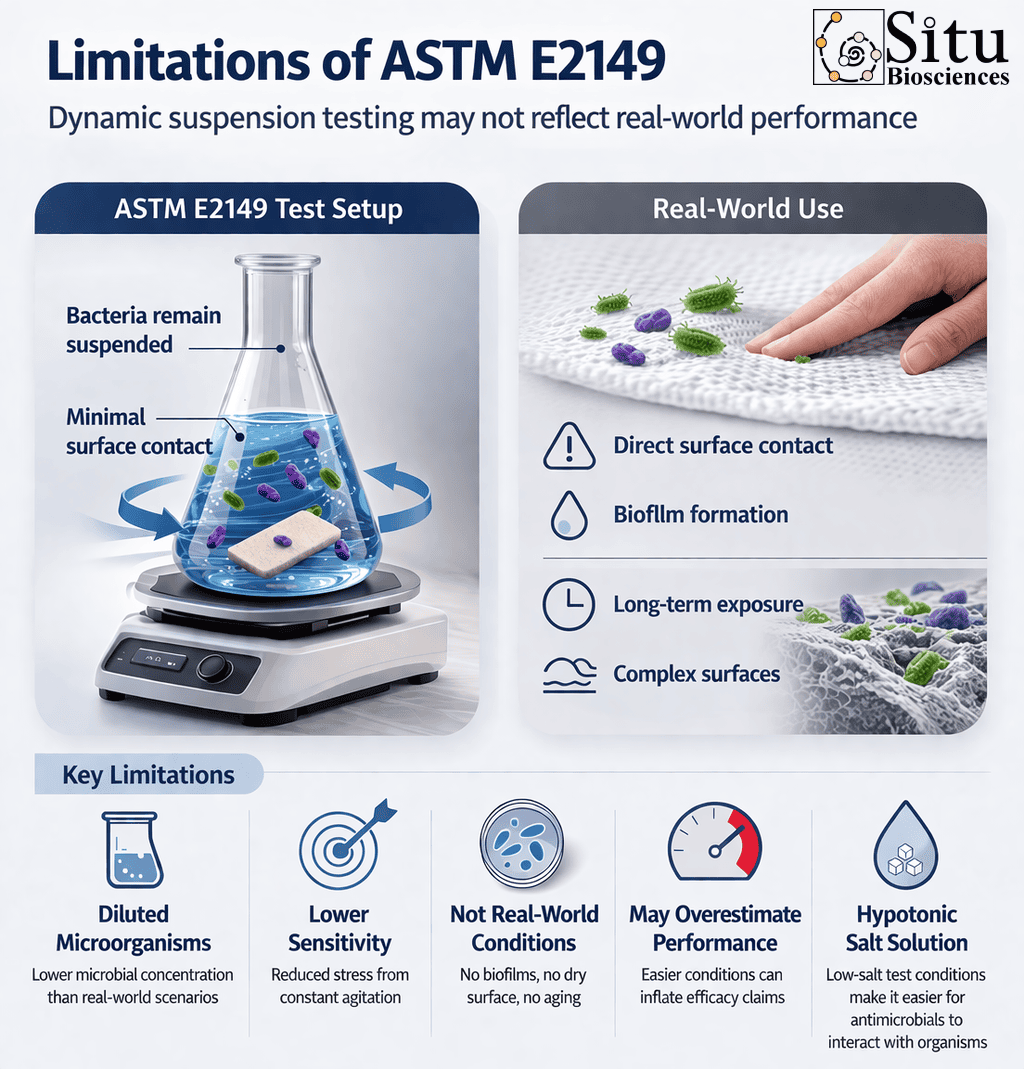
While the method can demonstrate antimicrobial activity in laboratory conditions, it does not replicate many real-world environments where microorganisms interact directly with surfaces rather than remaining suspended in liquid.
ASTM E2149 is often used for evaluating antimicrobial-treated materials such as polymers, coatings, plastics, and treated surfaces, particularly during early-stage material screening or comparative evaluations.
Overview
ASTM E2149 measures the reduction of bacterial populations in a liquid suspension after exposure to a treated material that is continuously agitated.
Because microorganisms remain suspended in solution during testing, the method evaluates antimicrobial activity under dynamic exposure conditions rather than direct surface contact.
For this reason, ASTM E2149 results may not accurately represent antimicrobial performance in environments where microorganisms settle onto surfaces and remain stationary.
The method is most commonly used during:
• early product development
• antimicrobial material screening
• comparative technology evaluation
It is less commonly used as a standalone indicator of real-world antimicrobial performance.
What ASTM E2149 Measures
ASTM E2149 measures the reduction of viable bacterial populations in a liquid suspension after exposure to a treated material.
The test evaluates antimicrobial activity by:
• exposing treated materials to bacteria suspended in solution
• maintaining constant agitation during incubation
• recovering surviving bacteria after the contact period
• quantifying bacterial survival using microbiological plating methods
Results are typically expressed as percent reduction or log reduction compared with untreated controls.
However, because bacteria are continuously diluted and mixed in solution, the results may reflect conditions that differ substantially from how antimicrobial materials perform during normal use.
How ASTM E2149 Testing Works
The ASTM E2149 method follows a standardized procedure designed to evaluate antimicrobial activity under dynamic suspension conditions.
1. Sample Preparation
Test materials are prepared as standardized specimens. Depending on the study design, materials may be conditioned or sterilized prior to testing.
2. Preparation of Bacterial Suspension
A bacterial suspension of known concentration is prepared using standardized microbial cultures.
3. Dynamic Exposure
The treated material is placed into a container containing the bacterial suspension.
The container is placed on an agitation device, maintaining continuous mixing throughout the test period.
This agitation keeps microorganisms suspended in solution rather than allowing them to remain in contact with the material surface.
4. Incubation
The suspension is incubated for a defined contact period under controlled laboratory conditions.
5. Recovery and Enumeration
Samples of the suspension are collected and surviving bacteria are quantified using standard microbiological plating techniques.
6. Calculation of Antimicrobial Activity
Bacterial counts from treated samples are compared with untreated controls to calculate bacterial reduction.
Common Test Organisms
ASTM E2149 is typically performed using standard bacterial strains.
| Organism | Type | Relevance |
|---|---|---|
| Staphylococcus aureus | Gram-positive | Common organism used in antimicrobial testing |
| Escherichia coli | Gram-negative | Representative Gram-negative bacterium |
.
Additional organisms may be included depending on study design.
Key Test Parameters
| Parameter | Typical Conditions |
|---|---|
| Test Type | Quantitative antibacterial reduction |
| Measurement | Colony forming units (CFU) |
| Contact Time | Typically 1–24 hours |
| Test Environment | Liquid suspension with agitation |
| Standard Organization | ASTM International |
.
Limitations of ASTM E2149
Dynamic suspension conditions
ASTM E2149 maintains microorganisms suspended in liquid during testing.
This environment differs significantly from real-world conditions where microorganisms typically settle onto surfaces and remain in contact with materials.
Limited surface contact evaluation
Because bacteria remain diluted in suspension, the method may not accurately measure antimicrobial performance that depends on direct surface contact.
Potential overestimation of antimicrobial activity
Continuous agitation can increase interactions between bacteria and antimicrobial agents released from the material, potentially producing results that are not representative of real-use conditions.
Laboratory environment
As with all microbiological test methods, ASTM E2149 is performed under controlled laboratory conditions and may not reflect complex environmental exposures encountered by materials in real-world applications.
When ASTM E2149 May Not Be the Best Method
ASTM E2149 may be less appropriate when evaluating antimicrobial materials that rely primarily on surface contact mechanisms.
In these situations, alternative methods may provide more relevant data.
| Method | Type | Purpose |
|---|---|---|
| ASTM E2149 | Quantitative (Dynamic) | Suspension-based antimicrobial activity |
| AATCC TM 100 | Quantitative | Measures bacterial reduction directly on textiles |
| AATCC TM 147 | Qualitative | Screening method evaluating inhibition zones |
| JIS L 1902 | Quantitative | Surface contact antimicrobial textile testing |
.
Improving Test Reliability with Certified Reference Materials
Microbiological testing methods such as ASTM E2149 can exhibit variability due to biological system complexity and differences in laboratory conditions.
One approach to improving confidence in test results is the use of Certified Reference Materials (CRMs).
Situ Biosciences produces CRMs designed to support antimicrobial testing and help laboratories validate test performance.
These materials can help laboratories:
• confirm proper method performance
• verify laboratory proficiency
• support ISO 17025 quality control procedures
Situ Biosciences CRMs are produced according to ISO 17034 requirements and verified using ISO 17025 testing methods.
Learn more here:
https://www.situbiosciences.com/product/certified-reference-materials-for-antimicrobial-testing/
References
ASTM International.
ASTM E2149 – Standard Test Method for Determining the Antimicrobial Activity of Immobilized Antimicrobial Agents Under Dynamic Contact Conditions.