
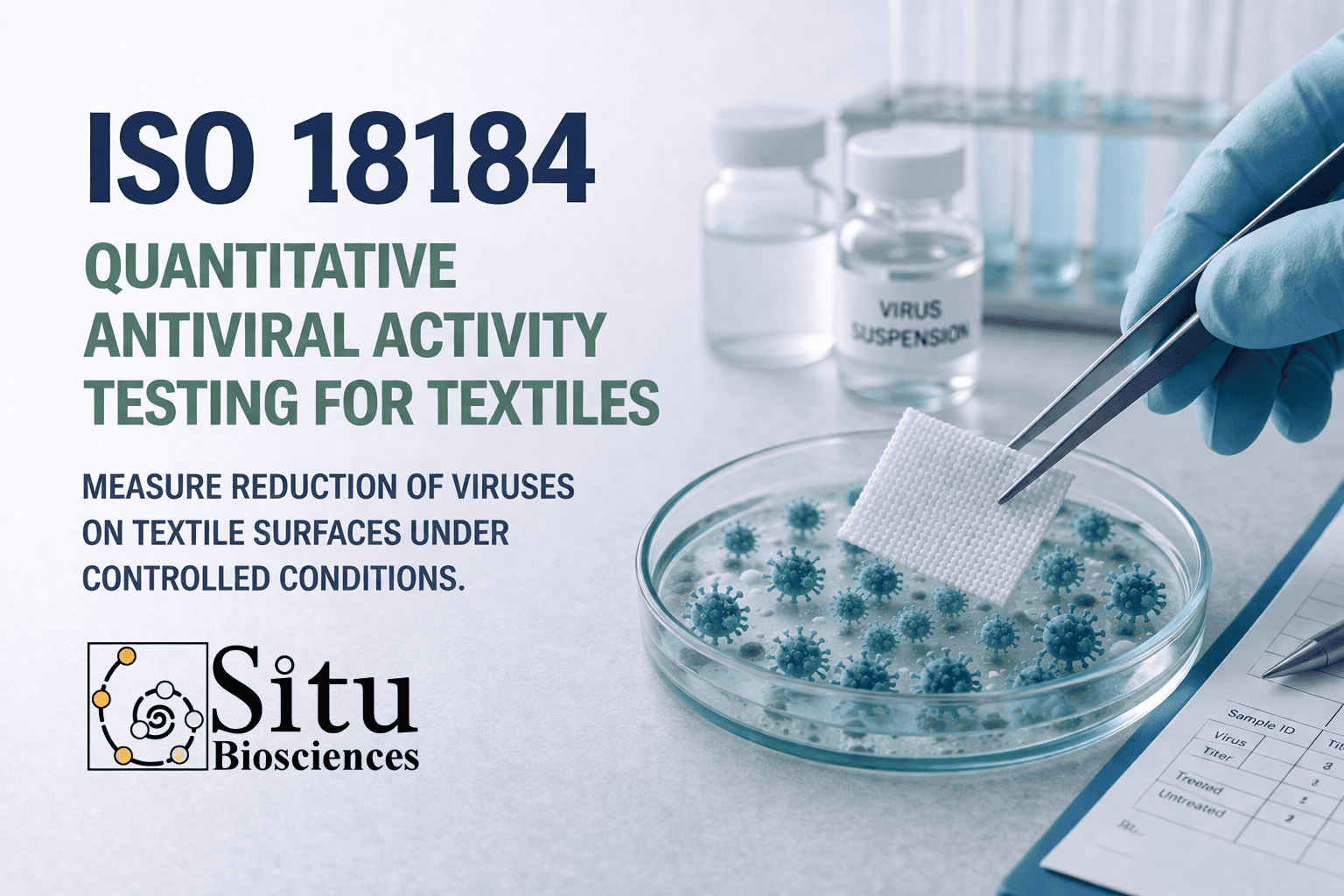
ISO 18184 testing quantifies antiviral activity by measuring the reduction of infectious virus particles on treated textile materials under controlled laboratory conditions.
ISO 18184 Testing: Antiviral Activity of Textile Products
What is ISO 18184?
ISO 18184 is a standardized test method used to determine the antiviral activity of textile products, including woven fabrics, knitted materials, and nonwoven textiles.
The method evaluates the reduction of infectious virus particles on treated textiles compared to untreated controls after a defined contact period.
Overview
ISO 18184 is the primary international standard for evaluating antiviral performance in textiles and is widely used across healthcare, apparel, and consumer product industries.
The method quantifies antiviral activity by measuring the reduction in virus infectivity after exposure to a treated textile under controlled laboratory conditions.
At Situ Biosciences, ISO 18184 testing is used to support antiviral claims, validate product performance, and generate defensible data for regulatory and commercial use.
What ISO 18184 Measures
ISO 18184 measures antiviral activity based on the reduction in infectious virus titre between treated and untreated textile samples.
The test evaluates:
- Reduction in viral infectivity (PFU or TCID50)
- Performance of antiviral-treated textiles
- Log reduction compared to control fabric
Results are expressed as a log reduction in viral infectivity, providing quantitative antiviral performance data.
How ISO 18184 Testing Works
ISO 18184 follows a controlled virology-based procedure designed specifically for textiles.
1. Sample Preparation
Textile specimens (~0.4 g total mass) are prepared from treated and untreated fabrics.
2. Virus Preparation
Test viruses are propagated in host cells and adjusted to a defined infectivity level.
3. Inoculation of Textile Samples
A defined volume of virus (typically 0.2 mL) is applied directly to the textile surface.
4. Contact Period
Samples are incubated under controlled conditions, typically:
- 25°C
- Standard contact time: 2 hours (can be extended depending on study design)
5. Recovery of Virus
Virus is extracted from the textile using a validated wash-out solution designed to neutralize antiviral activity.
6. Measurement of Infectivity
Recovered virus is quantified using:
- Plaque assay (PFU)
- TCID50 method
7. Calculation of Antiviral Activity
Antiviral performance is calculated based on log reduction compared to untreated control fabric.
Common Test Viruses
ISO 18184 includes commonly used viruses such as:
| Virus | Relevance |
|---|---|
| Influenza virus | Enveloped virus model |
| Feline calicivirus | Non-enveloped virus surrogate |
Additional viruses (including SARS-CoV-2) may be used depending on the application and validation requirements.
Key Test Parameters
| Parameter | Typical Conditions |
|---|---|
| Test Type | Quantitative antiviral |
| Measurement | Log reduction (PFU or TCID50) |
| Temperature | ~25°C |
| Contact Time | 2–24 hours |
| Material Type | Textiles |
| Endpoint | Viral infectivity |
| Standard Organization | ISO |
Benefits of ISO 18184
Quantitative antiviral performance data
Provides measurable reduction in viral infectivity on textiles.
Textile-specific methodology
Designed specifically for fabrics, yarns, and nonwoven materials.
Globally recognized standard
Widely accepted for antiviral textile testing.
Flexible virus selection
Allows testing with relevant viruses based on end-use application.
Supports regulatory and marketing claims
Generates defensible data for antiviral performance claims.
Limitations of ISO 18184
Controlled laboratory conditions
May not fully represent real-world exposure conditions.
Virus-specific results
Performance against one virus does not guarantee performance against others.
Complex virology requirements
Requires specialized cell culture and virology expertise.
Why Choose ISO 18184 Over Other Methods
ISO 18184 is the preferred method for quantitative antiviral evaluation of textile materials.
Improving Test Reliability with Certified Reference Materials
Antiviral testing introduces variability due to biological systems, viral propagation, and host cell interactions.
Certified Reference Materials (CRMs) help:
- Verify test system performance
- Support method validation
- Ensure consistency across studies
- Strengthen ISO 17025 compliance
Situ Biosciences provides CRMs produced in accordance with ISO 17034 and verified using ISO 17025 testing methods.
Learn more here:
https://www.situbiosciences.com/product/certified-reference-materials-for-antimicrobial-testing/
Applications of ISO 18184 Testing
ISO 18184 is widely used for:
- Medical and healthcare textiles
- Apparel and performance fabrics
- Air filtration materials
- Protective equipment
- Consumer textiles
- Industrial fabrics
Frequently Asked Questions
What does ISO 18184 measure?
It measures the reduction of infectious virus particles on textile materials.
What is the difference between PFU and TCID50?
Both measure viral infectivity, but PFU uses plaque counting while TCID50 estimates infectious dose.
How long is the test?
Standard contact time is 2 hours, but can be extended depending on requirements.
Can ISO 18184 be used for non-textiles?
No. It is specifically designed for textile materials.
Is ISO 18184 quantitative?
Yes. It provides quantitative antiviral performance data.
ISO 18184 Testing at Situ Biosciences
Situ Biosciences provides ISO 18184 antiviral testing for textile materials across a wide range of industries.
Testing programs can be tailored to support:
- antiviral performance validation
- product development
- regulatory submissions
- marketing and claims support
For more information about ISO 18184 testing or Certified Reference Materials, please contact Situ Biosciences.
References
ISO 18184 — Textiles — Determination of antiviral activity of textile products
Product Tests
Biodegradation Testing
Analytical Testing
Formulation Analytical Analysis
Product Development
Environmental & Durability Testing
Biodegradability Testing – Chemical Impact
Minimun Inhibitory Concentration
Minimum Biocidal Concentration
Quality Control Testing
Environmental Fate & Toxicology