
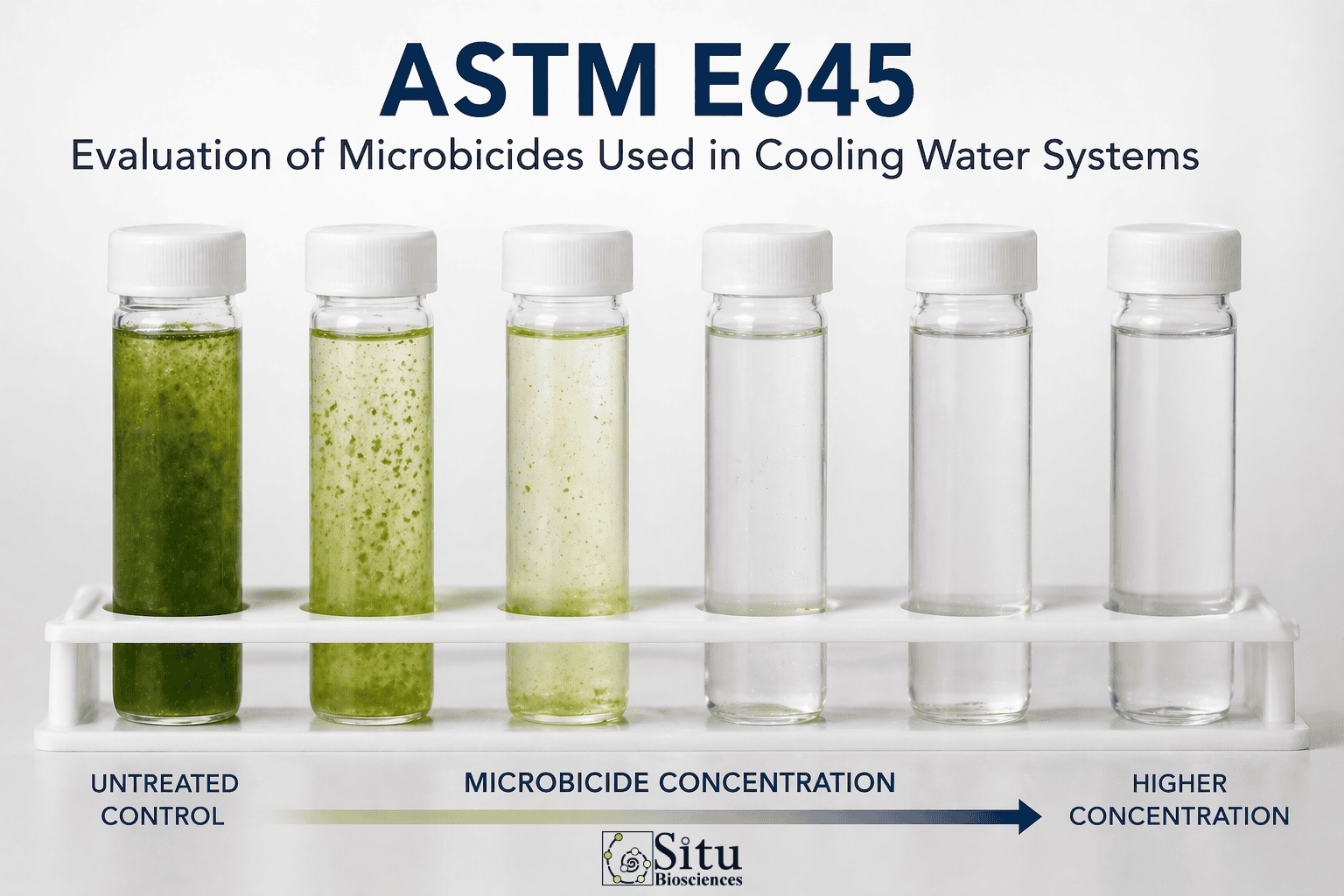
ASTM E645 Testing: Evaluation of Microbicides Used in Cooling Water Systems
What is ASTM E645?
ASTM E645 is a standardized test practice used to evaluate microbicides intended to control microbial growth in cooling water systems. The method can assess algicides, bactericides, and fungicides using simulated or real cooling tower water, cooling system microbes, biofilms, deposits, or known microorganisms associated with cooling water systems.
Overview
ASTM E645 evaluates the effectiveness of microbicides under conditions that simulate cooling water systems.
The method is commonly used for products intended to control microbial growth, biofouling, slime formation, algae, bacteria, and fungi in industrial cooling systems.
At Situ Biosciences, ASTM E645 testing can be used to evaluate microbicide performance, compare treatment concentrations, support product development, and generate data for customer or regulatory needs.
What ASTM E645 Measures
ASTM E645 measures the ability of a microbicide to reduce or control microbial populations in cooling water.
The method evaluates microbicide performance by:
- Using cooling water, simulated cooling water, or field-collected system water
- Introducing or evaluating bacteria, fungi, algae, biofilm, or deposits
- Adding microbicides at selected concentrations
- Measuring microbial populations after defined contact times
- Comparing treated samples to untreated controls
Results may be expressed as log reduction, percent kill, or growth/no-growth response depending on the organism and study design.
How ASTM E645 Testing Works
ASTM E645 uses a controlled laboratory procedure to evaluate microbicide performance in cooling water systems.
1. Cooling Water Sample Preparation
Cooling water may be used as received, filter-sterilized, or prepared synthetically depending on the study design. Field-collected deposits or biofilms may also be incorporated.
2. Microbial Challenge
The test may use microbes naturally present in cooling water, organisms from biofilms or deposits, or known microorganisms associated with cooling systems.
3. Microbicide Treatment
The microbicide is added at one or more selected concentrations. Concentrations are typically based on product use, registration range, or customer requirements.
4. Contact Period
The method includes defined exposure times. ASTM E645 specifies that 3-hour and 24-hour contact times must be included in each test.
5. Microbial Recovery
Samples are plated or evaluated using appropriate microbiological methods to determine remaining microbial populations.
6. Performance Calculation
Microbial reduction is calculated by comparing treated samples to control samples. Results may be reported as log reduction or percent kill.
Common Test Organisms
ASTM E645 may evaluate different microbial groups depending on the study objective.
| Organism Group | Relevance |
|---|---|
| Aerobic bacteria | Common contributors to cooling water microbial contamination |
| Anaerobic bacteria | May contribute to system biofouling or corrosion-related concerns |
| Fungi | May be present in cooling water systems or deposits |
| Algae | Important for algicide evaluation and visible fouling concerns |
| Biofilm-associated microorganisms | Represent microbial deposits and slime from operating systems |
Key Test Parameters
| Parameter | Typical Conditions |
|---|---|
| Test Type | Cooling water microbicide efficacy evaluation |
| Measurement | CFU, MPN, ATP, chlorophyll, or other validated methods |
| Contact Times | 3 hours and 24 hours required |
| Test Matrix | Cooling water, simulated cooling water, deposits, or biofilm |
| Organism Types | Bacteria, fungi, algae, or mixed microbial populations |
| Result Expression | Log reduction, percent kill, or growth/no-growth |
| Standard Organization | ASTM International |
Benefits of ASTM E645
Cooling system relevance
ASTM E645 is specifically designed for evaluating microbicides used in cooling water systems.
Flexible study design
The method can use field-collected cooling water, deposits, biofilms, or known microorganisms.
Supports product development
Manufacturers can use ASTM E645 to compare microbicide formulations and determine effective concentration ranges.
Evaluates multiple microbial groups
The method can assess bacteria, fungi, algae, or combinations of organisms depending on the application.
Useful for customer or registration needs
ASTM E645 allows investigators to establish acceptable efficacy based on customer requirements or specific registration needs.
Limitations of ASTM E645
Laboratory conditions may not fully predict field performance
ASTM E645 notes that laboratory results may not be fully predictive of field effectiveness because real cooling systems include variables such as blowdown rate, makeup water, pH, hardness, dissolved solids, hydrocarbon leaks, sediment loading, and biofilm deposits.
Microbial recovery can vary
Cooling water systems can contain complex microbial populations, and not all organisms may be recovered equally using standard media.
Biofilm complexity
Biofilms and deposits can affect microbicide performance and may be difficult to fully replicate in the laboratory.
Test design depends on study goals
Microbicide concentration, organism selection, exposure time, and performance thresholds must be selected based on the intended use.
Why Choose ASTM E645 Over Other Methods
| Method | Type | Purpose |
|---|---|---|
| ASTM E645 | Cooling water microbicide efficacy | Evaluates microbicides in simulated or real cooling water systems |
| ASTM E1054 | Neutralizer evaluation | Evaluates inactivators of antimicrobial agents |
| ASTM D4012 | ATP measurement | Measures microbial ATP in water |
| ASTM D4412 | Sulfate-reducing bacteria | Evaluates sulfate-reducing bacteria in water and deposits |
| ASTM E1326 | Nonconventional microbiological methods | Supports use of alternative microbial measurement methods |
ASTM E645 is selected when the goal is to evaluate microbicide performance specifically in cooling water environments.
Applications of ASTM E645 Testing
ASTM E645 is used for evaluating microbicides in industrial and commercial cooling water systems.
Common applications include:
- Cooling tower treatment products
- Industrial water treatment chemicals
- Algicide performance evaluation
- Bactericide performance evaluation
- Fungicide performance evaluation
- Biofilm and deposit-related microbial control
- Product development and formulation comparison
- Customer-specific efficacy testing
Frequently Asked Questions
What does ASTM E645 measure?
ASTM E645 measures the effectiveness of microbicides used to control microbial growth in cooling water systems.
What organisms can be evaluated?
The method can evaluate bacteria, fungi, algae, biofilm-associated microorganisms, or mixed microbial populations depending on the study design.
What contact times are used?
ASTM E645 requires 3-hour and 24-hour contact times, though additional timepoints may be included depending on the study objective.
Can ASTM E645 use real cooling tower water?
Yes. The method can use real cooling tower water, simulated cooling water, field-collected biofilms, deposits, or known microorganisms.
How are results reported?
Results may be reported as log reduction, percent kill, viable counts, or growth/no-growth depending on the organism and test design.
Cooling Water Microbicide Testing at Situ Biosciences
Situ Biosciences provides microbicide efficacy testing for cooling water systems and related industrial applications.
Testing programs can support:
- microbicide performance validation
- product development
- concentration screening
- cooling water treatment evaluation
- regulatory or customer-specific requirements
For more information about ASTM E645 testing, please contact Situ Biosciences.