
You are here: Home » ASTM D8646 Testing for Aquatic Biodegradation
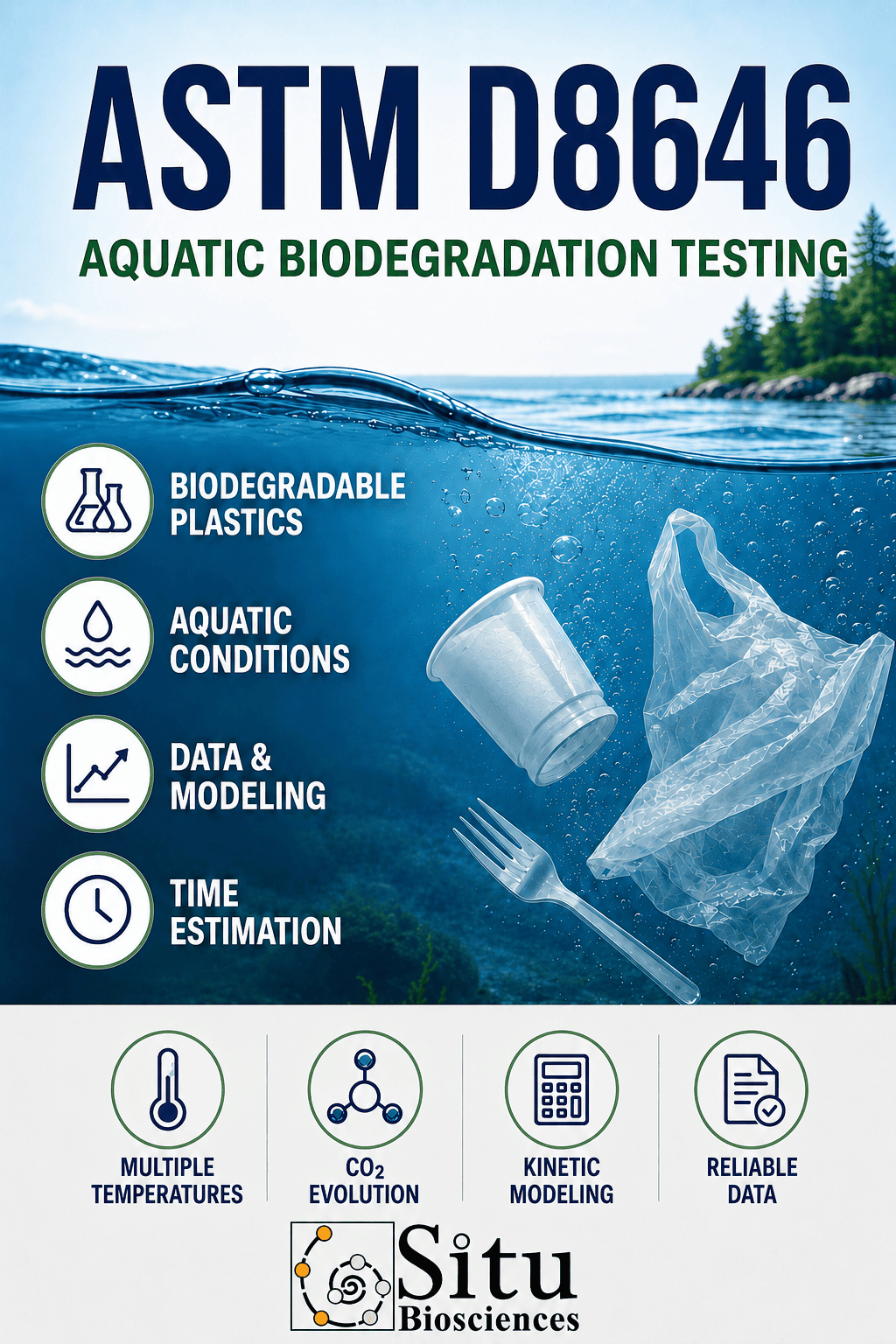
ASTM D8646 Testing for Aquatic Biodegradation
What is ASTM D8646?
ASTM D8646 is a standardized calculation and reporting method developed by ASTM International for estimating the biodegradation time of non-persistent biodegradable plastics intended for aerobic aquatic environments.
Unlike traditional biodegradation tests that measure biodegradation at a single point in time, ASTM D8646 uses experimental biodegradation data together with kinetic modeling to estimate how long a material may take to biodegrade under defined aquatic conditions.
The method is intended for non-floating biodegradable plastics used in:
- Marine environments
- Freshwater environments
- Brackish water environments
ASTM D8646 supports environmental fate assessments, product development, sustainability programs, and biodegradation documentation for aquatic-use plastics.
Overview
ASTM D8646 estimates biodegradation time using experimental biodegradation data generated from established laboratory methods.
Rather than directly measuring biodegradation itself, the standard analyzes data from methods such as:
- ASTM D6691
- ISO 14852
The method then applies temperature-based kinetic modeling to estimate the time required for polymer carbon to be converted into carbon dioxide through microbial metabolism.
At Situ Biosciences, ASTM D8646 can help clients evaluate aquatic biodegradation behavior, compare biodegradable materials, estimate environmental persistence, and support product development.
What ASTM D8646 Measures
ASTM D8646 estimates the time required for a biodegradable plastic to fully biodegrade under defined aerobic aquatic conditions.
The method evaluates:
- Polymer carbon conversion to carbon dioxide
- Aerobic biodegradation rate
- Temperature-dependent biodegradation behavior
- Estimated biodegradation time
- Potential environmental persistence
Results are typically reported as the estimated biodegradation time expressed in:
- Days
- Months
- Years
How ASTM D8646 Works
1. Material Review
The material is reviewed to determine whether ASTM D8646 is appropriate.
Typical considerations include:
- Polymer type
- Density
- Intended aquatic environment
- Floating behavior
- Product application
2. Experimental Biodegradation Testing
Biodegradation data are generated using recognized aquatic biodegradation methods such as:
- ASTM D6691
- ISO 14852
These studies provide the experimental biodegradation data required for ASTM D8646 calculations.
3. Temperature Evaluation
Biodegradation data are collected across multiple temperatures to evaluate how temperature affects degradation rate.
This is important because biodegradation may occur significantly slower in colder aquatic environments.
4. Carbon Dioxide Measurement
Underlying biodegradation studies measure conversion of polymer carbon into carbon dioxide produced through microbial metabolism.
This provides the biodegradation data used for kinetic modeling.
5. Kinetic Modeling
Experimental biodegradation data are analyzed using the mathematical model defined in ASTM D8646.
The model estimates biodegradation time under defined aquatic temperature conditions.
6. Reporting
The final report includes:
- Underlying biodegradation data
- Temperature conditions
- Modeling assumptions
- Estimated biodegradation time
- Project-specific interpretation
Common Test Conditions
| Parameter | Typical Conditions |
|---|---|
| Test Type | Biodegradation time estimation |
| Material | Non-floating biodegradable plastics |
| Environment | Aerobic aquatic |
| Aquatic Systems | Marine, freshwater, brackish |
| Underlying Test Methods | ASTM D6691, ISO 14852 |
| Primary Measurement | Carbon dioxide evolution |
| Output | Estimated biodegradation time |
| Standard | ASTM D8646 |
Benefits of ASTM D8646
Estimates Environmental Persistence
Provides an estimate of how long biodegradable plastics may remain in aquatic environments.
Uses Experimental Test Data
Calculations are based on recognized laboratory biodegradation methods rather than theoretical assumptions.
Incorporates Temperature Effects
Accounts for the influence of temperature on biodegradation rate.
Supports Product Development
Useful for comparing biodegradable polymer formulations during research and development.
Standardized Reporting
Provides a consistent framework for reporting estimated biodegradation time.
Limitations of ASTM D8646
Not a Standalone Test
ASTM D8646 requires experimental biodegradation data from methods such as ASTM D6691 or ISO 14852.
Material Specific
The method is intended for non-floating biodegradable plastics designed for aerobic aquatic environments.
Model-Based Results
Estimated biodegradation time depends on the quality of the underlying biodegradation data.
Does Not Justify Environmental Release
The standard should not be interpreted as supporting intentional disposal of plastics into aquatic environments.
Why Choose ASTM D8646?
| Method | Type | Primary Purpose |
|---|---|---|
| ASTM D8646 | Calculation Method | Estimate biodegradation time |
| ASTM D6691 | Experimental Test | Marine biodegradation |
| ISO 14852 | Experimental Test | Aerobic aqueous biodegradation |
| ASTM D5338 | Compost Test | Industrial compost biodegradation |
| ASTM D5511 | Anaerobic Test | High-solids anaerobic digestion |
ASTM D8646 is selected when estimating how long a biodegradable plastic may persist in an aquatic environment is more important than simply measuring the percentage of biodegradation achieved during a laboratory study.
Applications of ASTM D8646
Common applications include:
- Marine biodegradation evaluation
- Freshwater biodegradation studies
- Brackish water biodegradation
- Environmental fate assessment
- Plastic persistence evaluation
- Sustainable material development
- Biodegradable polymer comparison
- Product development
- Regulatory documentation
- Customer technical support
Frequently Asked Questions
What is ASTM D8646?
ASTM D8646 estimates the biodegradation time of biodegradable plastics intended for aerobic aquatic environments.
Is ASTM D8646 a biodegradation test?
No.
It is a calculation and reporting method that uses biodegradation data generated from methods such as ASTM D6691 or ISO 14852.
What types of plastics does ASTM D8646 apply to?
The method applies to non-floating biodegradable plastics designed for marine, freshwater, or brackish aquatic environments.
Why are multiple temperatures used?
Temperature significantly affects biodegradation rate.
ASTM D8646 incorporates temperature-dependent biodegradation data to estimate degradation time under different aquatic conditions.
Does ASTM D8646 replace ASTM D6691?
No.
ASTM D6691 generates the experimental biodegradation data that ASTM D8646 uses for biodegradation time estimation.
Can ASTM D8646 support sustainability claims?
ASTM D8646 may support environmental documentation and biodegradation evaluations, although claims should always be reviewed within the context of the underlying data and applicable regulations.
ASTM D8646 Testing at Situ Biosciences
Situ Biosciences provides biodegradation testing for plastics, polymers, coatings, and formulated materials.
Testing programs can support:
- Aquatic biodegradation testing
- Marine biodegradation studies
- ASTM D6691 testing
- ISO 14852 testing
- Biodegradation time estimation
- Environmental fate assessment
- Sustainability documentation
- Product development
- Regulatory support
For more information about ASTM D8646 testing, please contact Situ Biosciences.