
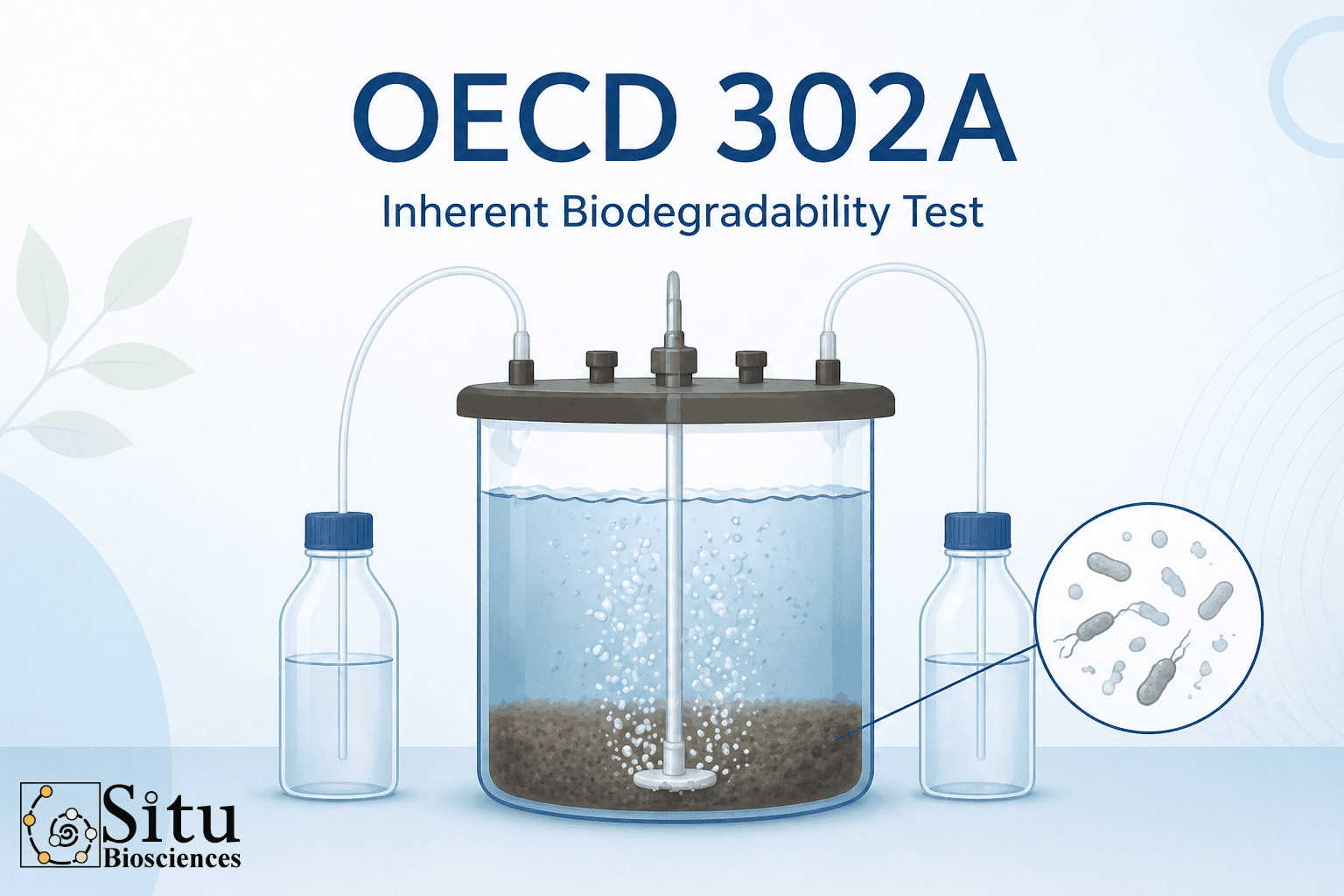
OECD 302A Testing: Modified SCAS Test for Inherent Biodegradability
What is OECD 302A?
OECD 302A is a standardized test method used to evaluate the inherent biodegradability of a substance under aerobic conditions.
Also known as the Modified SCAS Test, OECD 302A measures the removal of dissolved organic carbon (DOC) as microorganisms in activated sludge degrade a test substance over time.
Overview
OECD 302A is part of the OECD 302 series, which evaluates inherent biodegradability rather than ready biodegradability.
This method is commonly used when a substance does not meet ready biodegradability criteria but may still demonstrate significant biodegradation potential under more favorable or adapted microbial conditions.
At Situ Biosciences, OECD 302A testing can support product development, regulatory review, and environmental fate assessment.
What OECD 302A Measures
OECD 302A measures the reduction of dissolved organic carbon in a test system containing activated sludge.
The test evaluates biodegradation by:
- Introducing the test substance into activated sludge units
- Maintaining aerobic conditions
- Periodically replacing settled supernatant with fresh feed
- Measuring DOC removal over time
- Comparing treated units to control units
Results are expressed as percent DOC removal.
How OECD 302A Testing Works
1. Sample Preparation
The test substance is added at a known concentration to a test system containing activated sludge.
2. Activated Sludge Exposure
The test uses a semi-continuous activated sludge system designed to expose the substance to a highly active microbial population.
3. Aerobic Incubation
The system is maintained under aerobic conditions to support microbial degradation.
4. Regular Feeding and Settling
The test mixture is aerated, allowed to settle, and the supernatant is periodically replaced with fresh medium containing the test substance.
5. DOC Analysis
Dissolved organic carbon is measured in the effluent to determine how much organic carbon remains.
6. Calculation of Biodegradation
DOC removal is calculated by comparing the test substance units to appropriate controls.
Common Test Conditions
| Parameter | Typical Conditions |
|---|---|
| Test Type | Aerobic inherent biodegradability |
| Measurement | Dissolved Organic Carbon removal |
| Test System | Modified semi-continuous activated sludge |
| Inoculum | Activated sludge |
| Result Expression | Percent DOC removal |
| Standard Organization | OECD |
| Method Name | Modified SCAS Test |
Benefits of OECD 302A
Evaluates inherent biodegradability
OECD 302A is useful for substances that may not pass ready biodegradability testing but still have meaningful biodegradation potential.
Uses an active microbial system
The method uses activated sludge, providing strong microbial exposure under controlled aerobic conditions.
Useful for difficult substances
OECD 302A may be appropriate for materials that require more favorable degradation conditions than ready biodegradability screening provides.
Supports product development
The method can help compare formulations and determine whether a substance has biodegradation potential.
Limitations of OECD 302A
Not a ready biodegradability test
Passing OECD 302A does not mean a substance is “readily biodegradable.”
DOC removal may require interpretation
Loss of dissolved organic carbon may reflect biodegradation, adsorption, or other removal mechanisms.
Less conservative than OECD 301 methods
Because OECD 302A uses a more favorable test system, results should not be interpreted the same way as OECD 301 ready biodegradability results.
Why Choose OECD 302A Over Other Methods
| Method | Type | Purpose |
|---|---|---|
| OECD 301A | Ready biodegradability | DOC removal under stringent screening conditions |
| OECD 301B | Ready biodegradability | CO₂ evolution / mineralization |
| OECD 302A | Inherent biodegradability | DOC removal in activated sludge system |
| OECD 302B | Inherent biodegradability | Zahn-Wellens / EMPA test |
| OECD 302C | Inherent biodegradability | Modified MITI test |
OECD 302A is commonly selected when the goal is to evaluate whether a substance has inherent biodegradation potential under aerobic activated sludge conditions.
Applications of OECD 302A Testing
Common applications include:
- Chemical screening
- Environmental fate evaluation
- Product development
- Regulatory support
- Biodegradability claim support
- Comparison of formulations
- Evaluation of substances that do not meet ready biodegradability criteria
Frequently Asked Questions
What does OECD 302A measure?
OECD 302A measures the removal of dissolved organic carbon from a test substance in an aerobic activated sludge system.
Is OECD 302A a ready biodegradability test?
No. OECD 302A evaluates inherent biodegradability, not ready biodegradability.
What is the difference between OECD 301A and OECD 302A?
OECD 301A is a ready biodegradability screening method, while OECD 302A is an inherent biodegradability method using a more favorable activated sludge system.
Can OECD 302A support regulatory submissions?
Yes. OECD 302A may be used as part of environmental fate or biodegradability assessments, depending on the regulatory framework and intended claim.
Biodegradation Testing at Situ Biosciences
Situ Biosciences provides biodegradation testing for a wide range of materials including chemicals, polymers, coatings, and formulated products.
Testing programs can be designed to support:
- biodegradability screening
- regulatory compliance
- product development
- environmental claim validation
For more information about OECD 302A testing, please contact Situ Biosciences.