
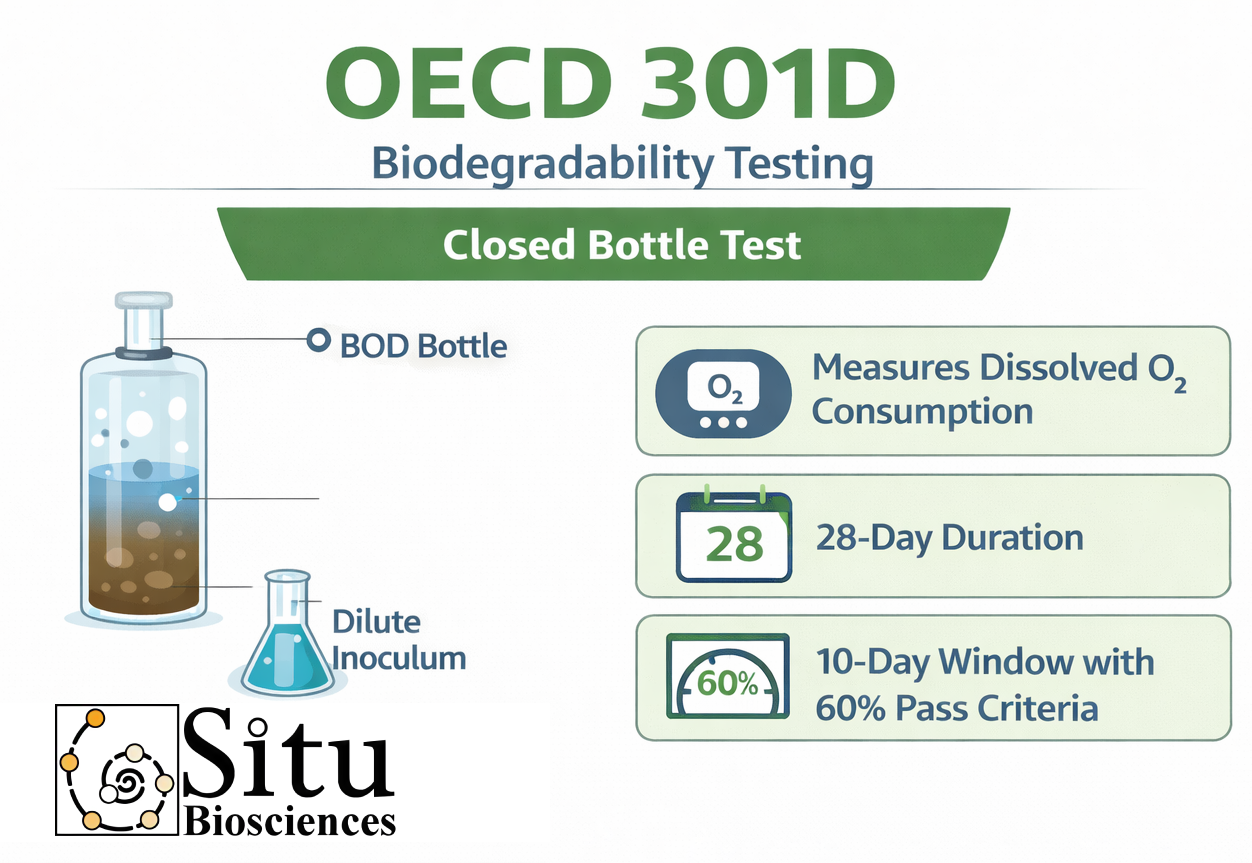
OECD 301D Biodegradability Testing – Closed Bottle Test
What is OECD 301D?
OECD 301D is a standardized test method used to evaluate the ready biodegradability of a substance by measuring oxygen consumption in a closed system under aerobic conditions. The method determines how effectively microorganisms degrade a substance over a 28-day period.
Overview
OECD 301D, also known as the Closed Bottle Test, is one of six OECD methods used to assess ready biodegradability in an aerobic aqueous environment.
The method is commonly used for substances tested at low concentrations and is particularly useful when evaluating materials that may be sensitive to higher microbial densities.
At Situ Biosciences, OECD 301D testing is performed to evaluate biodegradability, support regulatory submissions, and guide product development decisions.
What OECD 301D Measures
OECD 301D measures the amount of dissolved oxygen consumed as microorganisms degrade a test substance.
The test evaluates biodegradation by:
- Adding the test substance to a mineral medium at low concentration
- Inoculating with a small population of microorganisms
- Sealing the system in completely filled bottles
- Measuring dissolved oxygen depletion over time
- Comparing oxygen consumption to theoretical oxygen demand (ThOD)
Results are expressed as percent biodegradation based on oxygen consumption (ThOD).
Because the system is closed and oxygen is limited, careful measurement is required to ensure accuracy.
How OECD 301D Testing Works
The method follows a standardized aerobic biodegradation procedure using sealed vessels.
1. Sample Preparation
The test substance is added to a mineral medium, typically at low concentrations (often 2–10 mg/L).
2. Inoculum Addition
A dilute inoculum is introduced, typically from secondary sewage effluent or surface water.
3. Bottle Filling
BOD bottles are completely filled with no air space to prevent external oxygen exchange.
4. Incubation
Bottles are sealed and incubated in the dark at controlled temperature, typically around 20°C.
5. Oxygen Measurement
Dissolved oxygen is measured at intervals using either an oxygen electrode or Winkler titration.
6. Calculation of Biodegradation
Oxygen depletion (corrected for blanks) is compared to theoretical oxygen demand to calculate percent biodegradation.
Common Test Conditions
| Parameter | Typical Conditions |
|---|---|
| Test Type | Aerobic ready biodegradability |
| Measurement | Dissolved oxygen consumption |
| Duration | 28 days |
| Environment | Closed aqueous system |
| Inoculum | Dilute microbial population (effluent or surface water) |
| Result Expression | Percent biodegradation (ThOD) |
| Standard Organization | OECD |
Benefits of OECD 301D
Suitable for low concentrations
Designed for testing substances at low concentrations, reducing potential toxicity effects.
Sensitive to biodegradation
The closed system allows detection of small changes in oxygen consumption.
Regulatory acceptance
Widely accepted for screening biodegradability in regulatory frameworks.
Minimal equipment requirements
Can be performed with standard laboratory equipment such as BOD bottles.
Useful for difficult substances
Applicable to some substances that may not perform well in other test formats.
Limitations of OECD 301D
Strict pass criteria
To be classified as readily biodegradable, substances must reach ≥60% biodegradation within a 10-day window during the 28-day test.
Oxygen limitation
Because the system is closed, oxygen depletion must be carefully controlled to avoid invalid results.
Low concentration requirement
Test substance concentration is limited to prevent oxygen depletion below acceptable levels.
Potential variability
Results may vary depending on inoculum source and experimental handling.
Why Choose OECD 301D Over Other Methods
Different OECD 301 methods evaluate biodegradability using different analytical approaches.
| Method | Type | Purpose |
|---|---|---|
| OECD 301D | Oxygen consumption (closed system) | Measures biodegradation at low concentrations |
| OECD 301A | DOC removal | Measures dissolved organic carbon reduction |
| OECD 301B | CO₂ Evolution | Measures mineralization via CO₂ production |
| OECD 301F | Manometric Respirometry | Measures oxygen uptake in closed systems |
OECD 301D is commonly selected when low concentration testing and closed-system oxygen measurement are required.
our future™ Program – Biodegradability Certification
Situ Biosciences offers the our future™ Program, a data-driven biodegradability certification designed to validate product performance through scientifically backed testing.
The our future™ Certified Biodegradable designation is rooted directly in biodegradation test results generated in our ISO 17025 accredited laboratory. Certification is based on rigorous evaluation using globally recognized test methods, ensuring your product meets defined biodegradability criteria.
By participating in the our future™ Program, companies gain:
- Verified biodegradability certification based on test data
- Transparent reporting, with supporting data available to customers
- Use of the Certified Biodegradable logo for marketing and product claims
- Alignment with global standards and regulatory expectations
This program provides a clear, data-backed way to substantiate biodegradability claims while building trust with customers and stakeholders.
Supported Test Methods
The our future™ Program supports a wide range of biodegradation pathways and materials, including both liquid and solid products.
Ready Biodegradability
OECD 301A, OECD 301B, OECD 301C, OECD 301D, OECD 301E, OECD 301F, OECD 310, ASTM D5864
Inherent Biodegradability
OECD 302B, OECD 302C, OECD 302D
Marine Biodegradability
Anaerobic Biodegradability
Ultimate Biodegradability
Why Enroll in the our future™ Program
Biodegradability claims are increasingly scrutinized across industries. The our future™ Program provides:
- Scientifically defensible claims backed by validated test data
- Improved regulatory alignment across global markets
- A competitive advantage through verified environmental performance
- Confidence for customers and partners through transparent data access
Get Started
To learn more about the our future™ Program or begin certification:
📞 847-483-9950
📧 info@situtest.com
Applications of OECD 301D Testing
OECD 301D is widely used across industries for evaluating biodegradability.
Common applications include:
- Chemical screening
- Regulatory submissions
- Product development
- Environmental impact assessments
Frequently Asked Questions
What does OECD 301D measure?
OECD 301D measures dissolved oxygen consumption during microbial degradation of a substance.
How long does OECD 301D testing take?
The test typically runs for 28 days.
What qualifies as “readily biodegradable”?
A substance must achieve at least 60% biodegradation within a 10-day window during the test period.
Why is the system closed?
The closed system prevents external oxygen exchange, allowing precise measurement of oxygen consumption.
Can OECD 301D be used for regulatory submissions?
Yes. OECD 301D is widely accepted for regulatory biodegradability screening.
Biodegradation Testing at Situ Biosciences
Situ Biosciences provides biodegradation testing for a wide range of materials including chemicals, polymers, and coatings.
Testing programs can be designed to support:
- biodegradability screening
- regulatory compliance
- product development
- environmental claim validation
For more information about OECD 301D testing, please contact Situ Biosciences.