
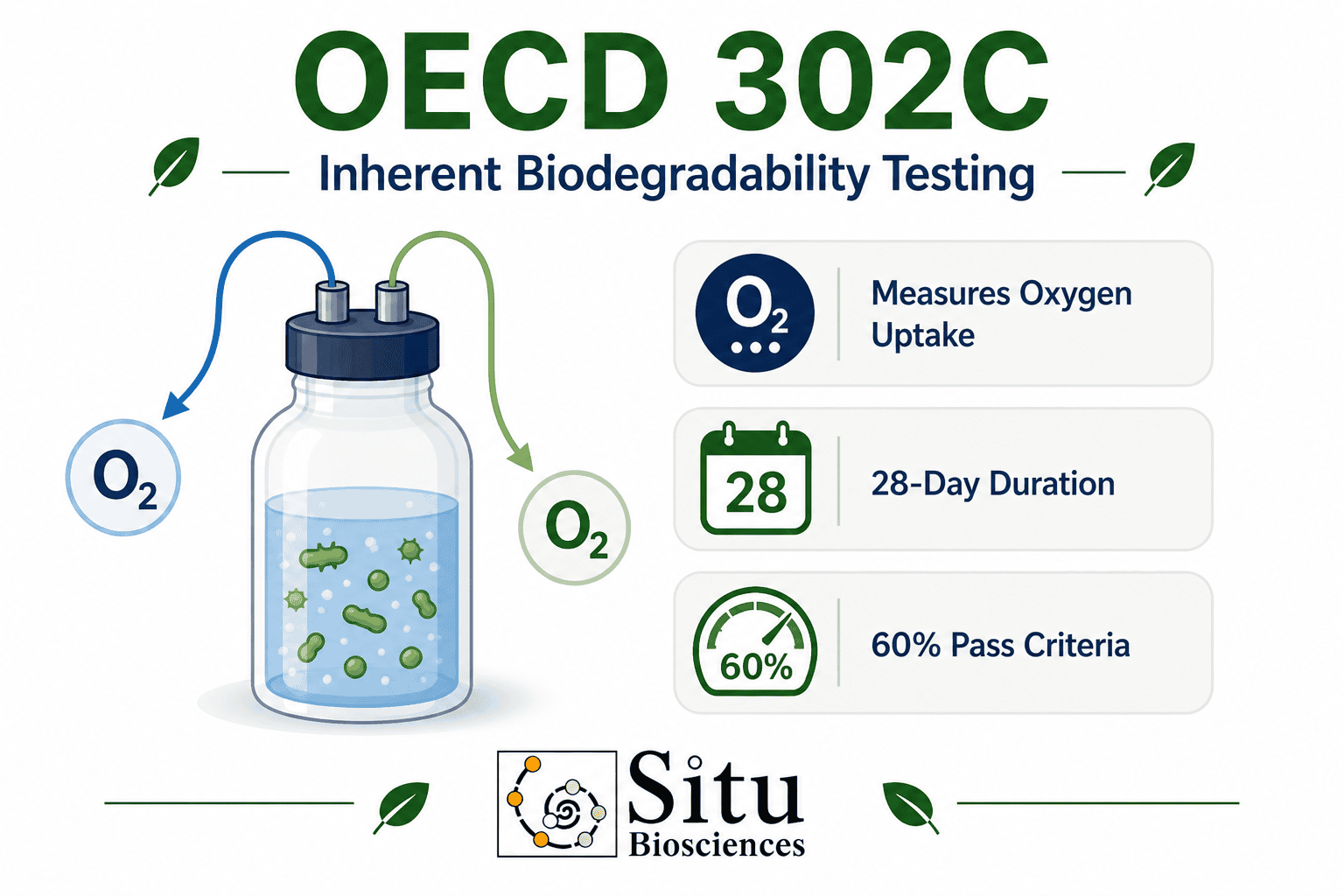
OECD 302C Testing: Modified MITI Test (II) for Inherent Biodegradability
What is OECD 302C?
OECD 302C is a standardized test method used to evaluate the inherent biodegradability of a substance under aerobic conditions.
Also known as the Modified MITI Test (II), OECD 302C measures the extent of biodegradation by monitoring oxygen consumption as microorganisms degrade a test substance.
Overview
OECD 302C is part of the OECD 302 series, which assesses inherent biodegradability rather than ready biodegradability.
This method is commonly used for substances that do not meet the strict criteria of OECD 301 tests but may still demonstrate significant biodegradation under more favorable conditions.
At Situ Biosciences, OECD 302C testing is used to evaluate biodegradation potential, support regulatory assessments, and guide product development.
What OECD 302C Measures
OECD 302C measures biodegradation by tracking oxygen consumption as microorganisms metabolize a test substance.
The test evaluates biodegradation by:
- Adding the test substance to a mineral medium
- Inoculating with microorganisms (typically activated sludge)
- Maintaining aerobic conditions
- Measuring oxygen uptake over time
- Comparing results to theoretical oxygen demand (ThOD)
Results are expressed as percent biodegradation based on oxygen consumption.
How OECD 302C Testing Works
1. Sample Preparation
The test substance is added to a mineral medium at a defined concentration suitable for inherent biodegradability testing.
2. Inoculum Addition
Microorganisms are introduced, typically from activated sludge or environmental sources.
3. Aerobic Incubation
The test is conducted under controlled aerobic conditions using sealed respirometric systems.
4. Oxygen Monitoring
Oxygen consumption is continuously or periodically measured as microorganisms degrade the substance.
5. Data Analysis
Oxygen uptake is compared to theoretical oxygen demand (ThOD) to calculate percent biodegradation.
Common Test Conditions
| Parameter | Typical Conditions |
|---|---|
| Test Type | Aerobic inherent biodegradability |
| Measurement | Oxygen consumption (respirometry) |
| Duration | Up to 28 days |
| Environment | Aqueous aerobic system |
| Inoculum | Activated sludge |
| Result Expression | Percent biodegradation (based on ThOD) |
| Standard Organization | OECD |
| Method Name | Modified MITI Test (II) |
Benefits of OECD 302C
Measures biodegradation via oxygen uptake
Provides a direct indication of microbial respiration and metabolic activity.
Suitable for a wide range of substances
Effective for evaluating chemicals that may not meet ready biodegradability criteria.
Standardized respirometric approach
Widely recognized method using established oxygen consumption measurements.
Supports regulatory assessments
Used in environmental fate studies and regulatory evaluations.
Useful for product development
Helps assess and compare biodegradation potential across formulations.
Limitations of OECD 302C
Not a ready biodegradability test
Results cannot be used to claim “readily biodegradable.”
Requires accurate ThOD estimation
Calculation of biodegradation depends on correct theoretical oxygen demand values.
Less stringent than OECD 301 methods
The test environment is more favorable, so results are not directly comparable to ready biodegradability tests.
Interpretation may be required
Oxygen consumption may include processes beyond complete mineralization.
Why Choose OECD 302C Over Other Methods
| Method | Type | Purpose |
|---|---|---|
| OECD 301B | Ready biodegradability | CO₂ evolution |
| OECD 301F | Ready biodegradability | Oxygen uptake |
| OECD 302A | Inherent biodegradability | Activated sludge semi-continuous system |
| OECD 302B | Inherent biodegradability | DOC/COD removal |
| OECD 302C | Inherent biodegradability | Oxygen consumption (respirometry) |
OECD 302C is commonly selected when evaluating inherent biodegradability using a respirometric approach based on oxygen uptake.
Applications of OECD 302C Testing
Common applications include:
- Environmental fate assessment
- Regulatory submissions
- Product development
- Screening of difficult or poorly biodegradable substances
- Evaluation of formulations
- Supporting biodegradability claims (non-ready)
Frequently Asked Questions
What does OECD 302C measure?
OECD 302C measures oxygen consumption as microorganisms degrade a substance under aerobic conditions.
Is OECD 302C a ready biodegradability test?
No. It evaluates inherent biodegradability under more favorable conditions.
What is the difference between OECD 301F and OECD 302C?
Both measure oxygen uptake, but OECD 301F is a stringent ready biodegradability test, while OECD 302C evaluates inherent biodegradability under less restrictive conditions.
What indicates biodegradation in OECD 302C?
Biodegradation is indicated by oxygen consumption relative to the theoretical oxygen demand (ThOD).
Can OECD 302C be used for regulatory submissions?
Yes. It is commonly used in environmental fate and regulatory evaluations.
our future™ Program – Biodegradability Certification
Situ Biosciences offers the our future™ Program, a data-driven biodegradability certification designed to validate product performance through scientifically backed testing.
The our future™ Certified Biodegradable designation is rooted directly in biodegradation test results generated in our ISO 17025 accredited laboratory. Certification is based on rigorous evaluation using globally recognized test methods, ensuring your product meets defined biodegradability criteria.
By participating in the our future™ Program, companies gain:
- Verified biodegradability certification based on test data
- Transparent reporting, with supporting data available to customers
- Use of the Certified Biodegradable logo for marketing and product claims
- Alignment with global standards and regulatory expectations
This program provides a clear, data-backed way to substantiate biodegradability claims while building trust with customers and stakeholders.
Supported Test Methods
The our future™ Program supports a wide range of biodegradation pathways and materials, including both liquid and solid products.
Ready Biodegradability
OECD 301A, OECD 301B, OECD 301C, OECD 301D, OECD 301E, OECD 301F, OECD 310, ASTM D5864
Inherent Biodegradability
OECD 302B, OECD 302C, OECD 302D
Marine Biodegradability
Anaerobic Biodegradability
Ultimate Biodegradability
Why Enroll in the our future™ Program
Biodegradability claims are increasingly scrutinized across industries. The our future™ Program provides:
- Scientifically defensible claims backed by validated test data
- Improved regulatory alignment across global markets
- A competitive advantage through verified environmental performance
- Confidence for customers and partners through transparent data access
Biodegradation Testing at Situ Biosciences
Situ Biosciences provides biodegradation testing for a wide range of materials including chemicals, polymers, coatings, and formulated products.
Testing programs can be designed to support:
- biodegradability screening
- regulatory compliance
- product development
- environmental claim validation
For more information about OECD 302C testing, please contact Situ Biosciences.