
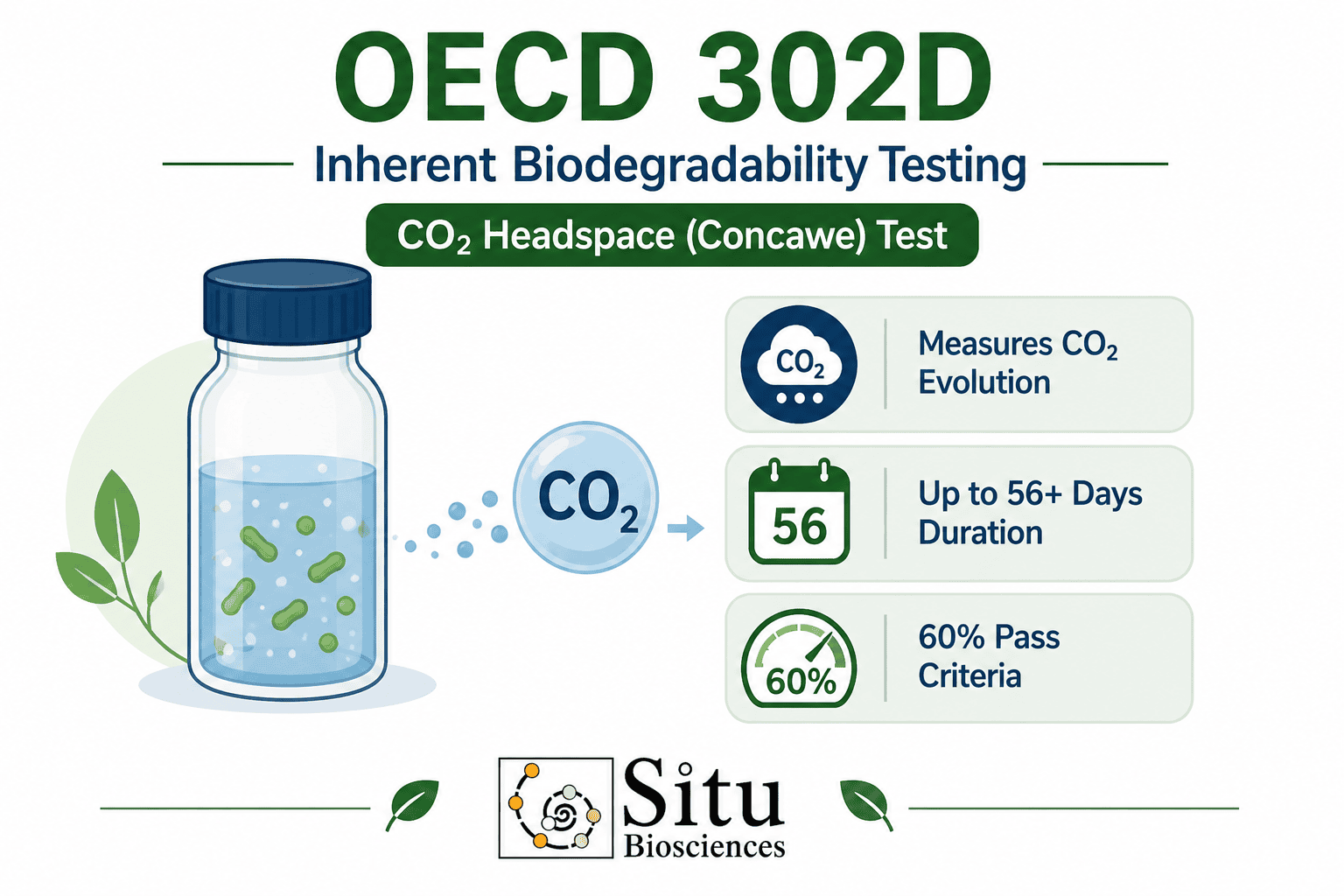
OECD 302D Testing: Concawe Test (CO₂ Headspace) for Inherent Biodegradability
What is OECD 302D?
OECD 302D is a standardized test method used to evaluate the inherent biodegradability of a substance under aerobic conditions.
Also known as the Concawe Test, OECD 302D measures biodegradation by monitoring carbon dioxide (CO₂) production in a sealed system.
Overview
OECD 302D is part of the OECD 302 series, which assesses inherent biodegradability rather than ready biodegradability.
This method is particularly useful for:
- Insoluble substances
- Volatile substances
- Complex formulations
The test is based on a CO₂ headspace approach, where biodegradation is determined by measuring inorganic carbon (IC) formed from microbial metabolism.
At Situ Biosciences, OECD 302D testing can support environmental fate evaluation, regulatory submissions, and product development.
What OECD 302D Measures
OECD 302D measures ultimate biodegradation by quantifying CO₂ production.
The test evaluates biodegradation by:
- Incubating the test substance in a mineral medium
- Inoculating with a mixed microbial population
- Measuring inorganic carbon (IC) produced
- Comparing results to blank controls
Results are expressed as percent biodegradation relative to theoretical inorganic carbon (ThIC).
How OECD 302D Testing Works
1. Sample Preparation
The test substance is added to a mineral salts medium at a defined concentration.
2. Inoculum Preparation
A composite inoculum is used, typically derived from:
- Soil
- Activated sludge
The inoculum is often pre-exposed to the test substance to enhance biodegradation potential.
3. Sealed Bottle Setup
The test is conducted in sealed bottles with a defined headspace-to-liquid ratio to allow oxygen availability.
4. Aerobic Incubation
The system is incubated under controlled temperature (~20°C) with continuous mixing.
5. CO₂ Measurement
Biodegradation is determined by measuring inorganic carbon (IC) produced from CO₂ evolution.
6. Calculation of Biodegradation
Results are calculated as percent of theoretical inorganic carbon (ThIC).
Common Test Conditions
| Parameter | Typical Conditions |
|---|---|
| Test Type | Aerobic inherent biodegradability |
| Measurement | CO₂ evolution (inorganic carbon) |
| Duration | Up to 56 days (or longer if needed) |
| Environment | Sealed aqueous system |
| Inoculum | Pre-exposed mixed microbial population |
| Result Expression | Percent biodegradation (ThIC) |
| Standard Organization | OECD |
| Method Name | Concawe Test / CO₂ Headspace Test |
Benefits of OECD 302D
Suitable for difficult substances
Effective for insoluble, volatile, and complex materials.
Measures ultimate biodegradation
Tracks mineralization to CO₂, providing strong evidence of biodegradation.
Enhanced microbial activity
Pre-exposure of inoculum increases biodegradation potential.
Flexible analytical approach
Allows additional measurements such as DOC removal or primary degradation.
Supports environmental fate assessment
Useful for evaluating substances that fail ready biodegradability tests.
Limitations of OECD 302D
Not a ready biodegradability test
Results cannot be used to claim “readily biodegradable.”
More favorable test conditions
Pre-exposed inoculum makes results less conservative than OECD 301 tests.
Longer test duration
Tests may extend beyond 28 days (often up to 56 days or longer).
Interpretation required
Partial degradation may indicate transformation rather than full mineralization.
Why Choose OECD 302D Over Other Methods
| Method | Type | Purpose |
|---|---|---|
| OECD 301B | Ready biodegradability | CO₂ evolution (strict conditions) |
| OECD 302A | Inherent biodegradability | Semi-continuous sludge system |
| OECD 302B | Inherent biodegradability | DOC/COD removal |
| OECD 302C | Inherent biodegradability | Oxygen uptake |
| OECD 302D | Inherent biodegradability | CO₂ headspace (Concawe test) |
OECD 302D is commonly selected when evaluating ultimate biodegradation of difficult substances, especially those that are insoluble or volatile.
Applications of OECD 302D Testing
Common applications include:
- Environmental fate assessment
- Regulatory submissions
- Product development
- Testing of oils, lubricants, and hydrophobic materials
- Evaluation of poorly soluble substances
- Supporting biodegradability claims (inherent, not ready)
Frequently Asked Questions
What does OECD 302D measure?
OECD 302D measures CO₂ production as microorganisms degrade a substance under aerobic conditions.
Is OECD 302D a ready biodegradability test?
No. It evaluates inherent biodegradability under more favorable conditions.
What is the difference between OECD 301B and OECD 302D?
Both measure CO₂ evolution, but OECD 301B is a stringent ready biodegradability test, while OECD 302D uses pre-exposed inoculum and is less restrictive.
What indicates biodegradation in OECD 302D?
Biodegradation ≥60% of theoretical inorganic carbon (ThIC) indicates strong inherent biodegradability.
Can OECD 302D be used for regulatory submissions?
Yes. It is commonly used in environmental fate and inherent biodegradability assessments.
our future™ Program – Biodegradability Certification
Situ Biosciences offers the our future™ Program, a data-driven biodegradability certification designed to validate product performance through scientifically backed testing.
The our future™ Certified Biodegradable designation is rooted directly in biodegradation test results generated in our ISO 17025 accredited laboratory. Certification is based on rigorous evaluation using globally recognized test methods, ensuring your product meets defined biodegradability criteria.
By participating in the our future™ Program, companies gain:
- Verified biodegradability certification based on test data
- Transparent reporting, with supporting data available to customers
- Use of the Certified Biodegradable logo for marketing and product claims
- Alignment with global standards and regulatory expectations
This program provides a clear, data-backed way to substantiate biodegradability claims while building trust with customers and stakeholders.
Supported Test Methods
The our future™ Program supports a wide range of biodegradation pathways and materials, including both liquid and solid products.
Ready Biodegradability
OECD 301A, OECD 301B, OECD 301C, OECD 301D, OECD 301E, OECD 301F, OECD 310, ASTM D5864
Inherent Biodegradability
OECD 302B, OECD 302C, OECD 302D
Marine Biodegradability
Anaerobic Biodegradability
Ultimate Biodegradability
Why Enroll in the our future™ Program
Biodegradability claims are increasingly scrutinized across industries. The our future™ Program provides:
- Scientifically defensible claims backed by validated test data
- Improved regulatory alignment across global markets
- A competitive advantage through verified environmental performance
- Confidence for customers and partners through transparent data access
Biodegradation Testing at Situ Biosciences
Situ Biosciences provides biodegradation testing for a wide range of materials including chemicals, polymers, coatings, and formulated products.
Testing programs can be designed to support:
- biodegradability screening
- regulatory compliance
- product development
- environmental claim validation
For more information about OECD 302D testing, please contact Situ Biosciences.